
REVIEW · KINDERDIJK
8 hour Walking and Boat Tour to Rotterdam and Kinderdijk
Rotterdam feels different when you walk it block by block. This tour strings together the city’s icons, bridges, and water story, then adds the famous polder windmills at Kinderdijk.
I especially love the tight, guided route and how it makes landmarks like Rotterdam Centraal and Erasmus feel connected, not random. I also like the small group size up to 4, which keeps the pace human and the questions coming.
One caution: you’re on your feet for much of the day, so if you have mobility concerns, plan for lots of walking between stops.
In This Review
- Key things I’d circle before booking
- Rotterdam by foot, then Kinderdijk by boat and bus: what this day is really like
- Price and logistics: what you’re paying for, and when it makes sense
- The morning build-up: Rotterdam Centraal, Partners, and the city’s surviving landmarks
- Quick practical tip for these early stops
- Erasmus, Markthal, and Kijk-Kubus: modern Rotterdam that still feels human
- Oude Haven to the river crossings: the city’s older port energy, then modern bridges
- Maritiem Museum Rotterdam and Erasmus Bridge: when you get a break from walking
- Kinderdijk windmills: the 3-hour payoff and the one extra ticket you must plan for
- The included snack and coffee break: small comfort, big pacing effect
- What you will notice most with Alex as your guide
- Who this tour is best for, and who should think twice
- Should you book the Rotterdam and Kinderdijk walking plus boat day?
- FAQ
- What is the duration of the tour?
- How many people are in the group?
- What is the price, and does it cover everyone?
- Where does the tour start?
- How long do you spend in Kinderdijk?
- Is the Kinderdijk ticket included?
- What’s included in the price?
- Do I need to buy tickets for Kijk-Kubus?
- Do I get a mobile ticket?
- What is the cancellation policy?
Key things I’d circle before booking
- Up to 4 people, so you get more guide time and fewer crowds to fight through
- A focused Rotterdam loop, from Rotterdam Centraal to bridges across the New Meuse
- Kinderdijk timing built in, with about 3 hours there to see the windmills properly
- Good value add-ons, including patatje oorlog and coffee or tea during the day
- Entrance to Kijk-Kubus included, so you do not have to hunt tickets mid-tour
- Your Kinderdijk admission is the only major extra, at €19 per person
Windmill days around Rotterdam, compared
- Rotterdam: Waterbus Ticket to Dordrecht and/or Kinderdijk★ 4.6 · 542 reviews
- All-Inclusive Private Windmill Tour to Kinderdijk from Rotterdam★ 4.5 · 59 reviews
- Kinderdijk Bike Tour★ 5.0 · 35 reviews
- Kinderdijk Area Cycling Tour★ 5.0 · 17 reviews
Rotterdam by foot, then Kinderdijk by boat and bus: what this day is really like
This is a day for people who like their sightseeing to have a thread. You start in central Rotterdam, get a guided walk through the parts people photograph for a reason, and then you head out to Kinderdijk to see the windmills that explain how the Dutch manage water at scale. It’s not a “rush to everything” tour. It’s structured, with enough time at each stop to read the room, look around, and understand what you’re seeing.
The tour also leans into the city’s relationship with water. Rotterdam is not just buildings and bridges. It’s a place shaped by policy, engineering, and constant work. That theme shows up from the early stops near water management history, through the river crossings and memorial spots along the New Meuse, and finally at Kinderdijk, where the polder windmills are the visual proof.
If you’re wondering about the guide, Alex is one of the reasons people rate this so highly. He’s the type who points out details you would otherwise miss and keeps the story coherent from Rotterdam to Kinderdijk.
Price and logistics: what you’re paying for, and when it makes sense
The price is $591.46 per group, for up to 4 travelers. That sounds like a lot until you break it down by group size. If you’re traveling with three friends or family members, the cost per person shrinks fast, and you’re basically buying a private-feeling day with a guide, transportation, and several admissions handled.
Here’s what’s included that helps justify the total:
- A guide through the day
- Coffee and/or tea
- A snack of patatje oorlog (the famous Rotterdam fries snack)
- Bus transportation from Rotterdam to Kinderdijk and back
- Entrance fees to Kijk-Kubus
- Your tickets for bus transport (so you’re not juggling paperwork mid-day)
Not included:
- Kinderdijk admission at €19 per person
That means you should budget one extra payment for Kinderdijk and nothing else major beyond snacks you might want on your own. In return, you get a route that covers a lot of distance efficiently and keeps you from losing time figuring out connections.
The morning build-up: Rotterdam Centraal, Partners, and the city’s surviving landmarks
You start at Stationsplein 48, right by Rotterdam Centraal Station. It’s the main railway station with around 170,000 passengers daily, and even if you’ve seen big stations before, Rotterdam Centraal feels like a city statement. You get a short stop, about 20 minutes, and the goal is not a deep architecture seminar. It’s time to get your bearings in a place that anchors the city.
Next you head to Rotterdam Partners, described as the 17th-century building that used to be headquarters for Waterschap Schieland, the institution responsible for water policy and management in this part of South Holland. This is one of those stops that quietly changes your perspective. Rotterdam’s engineering is not separate from daily life. It’s the backbone.
Then comes Grote of Sint-Laurenskerk, a late Gothic church building from 1525. It’s also noted as the oldest building in Rotterdam and one that survived the Nazi bombing on May 15, 1940. Even with a brief stop of about 10 minutes, it works because it gives the day a sense of continuity. You see layers of time, not just shiny modern contrasts.
Quick practical tip for these early stops
The early sequence is mostly short entry points. That’s actually helpful. It gets you into walking rhythm before the day opens up.
Still in Rotterdam? Keep going

Erasmus, Markthal, and Kijk-Kubus: modern Rotterdam that still feels human
From there you move through three landmarks that represent different kinds of “Rotterdam identity,” not all of them tall buildings.
First is the Erasmus sculpture, honoring Desiderius Erasmus of Rotterdam. Erasmus is tied to education and institutions across the city, and the sculpture acts like a wayfinder. You start connecting names on signs to people and ideas that shaped the city.
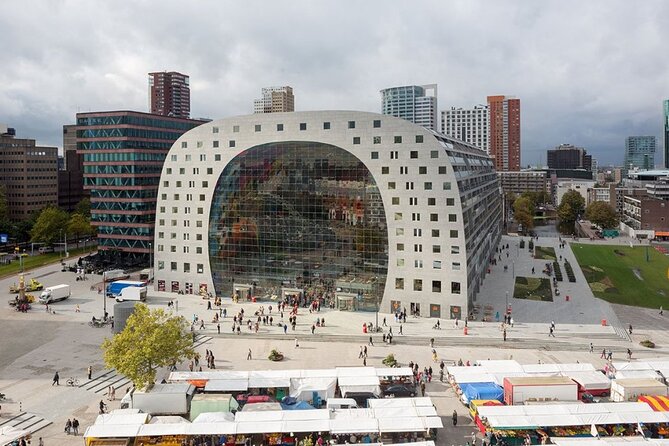
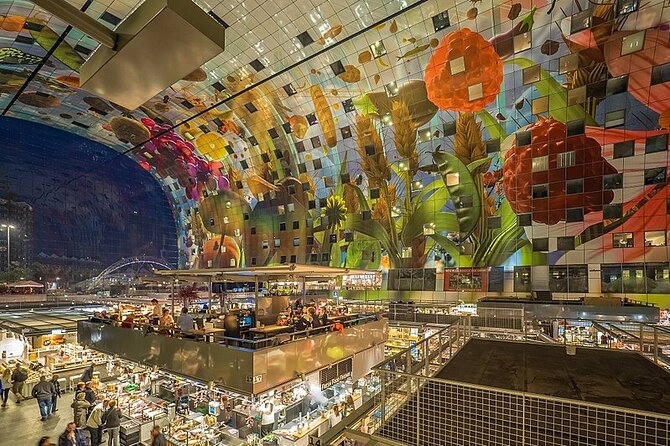
Then you reach Markthal. This building is modern and horseshoe-shaped, combining a market with living space. It’s often nicknamed the Sistine Chapel of Rotterdam, which makes you expect art and drama. Even if you do not go deep into the market side, Markthal is worth the stop because it’s a recognizable Rotterdam postcard that also shows how the city reuses space creatively.
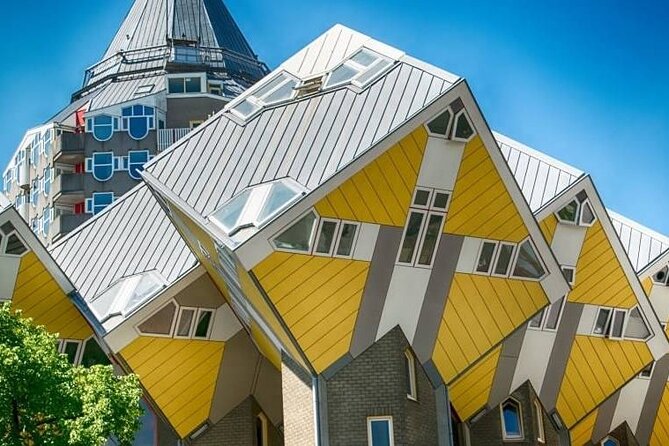
Finally, the tour includes time at Kijk-Kubus, the tree-like structure with cube-shaped apartments on top of supporting columns. Here’s the key detail you should notice while you’re there: because of the form, only 3/4 of the inner space is suitable for common living. That’s an architectural choice with real consequences, and it’s exactly the kind of nuance a guide can explain fast.
This stop is also one of the included admissions. That matters because you avoid the small hassle of paying separately once you’re already on the move.
Oude Haven to the river crossings: the city’s older port energy, then modern bridges
After the early core, the atmosphere shifts to water-adjacent life.
Oude Haven is a favorite gathering place. It’s described as one of the oldest ports of medieval Rotterdam, tied to the former Rotte River mouth before it met the New Meuse. Today it’s packed with coffee bars, restaurants, taverns, and even disco clubs. The stop runs about 1 hour, which is the tour’s way of saying, Slow down here. This is where Rotterdam feels like a living city instead of a photo lineup.
From Oude Haven, you head toward some of the most dramatic views and walk-by moments.
You’ll see Witte Huis, once the highest building and the first skyscraper in Europe after erected in 1898, built on 1000 wooden pillars. That’s a classic Rotterdam engineering detail that makes the skyline feel grounded in practical solutions rather than pure ambition.
Then comes a series of bridge stops:
- Willemsbrug, the Red Bridge, dedicated to Willem III
- De Hef, a huge steel lifting bridge once used as a train bridge across the New Meuse, working before the rail tunnel era
- De Boeg, a war memorial along the embankment commemorating 3500 persons on Dutch merchant ships who died in World War II
These stops are short, mostly 10 to 15 minutes each, but they add up to a clear pattern. You start to understand Rotterdam’s movement system, how crossings work, and how memory is placed right into the riverfront.
Maritiem Museum Rotterdam and Erasmus Bridge: when you get a break from walking

You’ll also spend time at Maritiem Museum Rotterdam at Leuvehaven, described as an open-air maritime museum. It focuses on steamships and cargo equipment, ship engines, and related objects spanning from the mid-19th century to the 1970s. The stop is around 20 minutes. Even if you do not spend forever reading every placard, the open-air approach is smart for a walking day. You can pause, look, and keep moving without committing to an indoor museum schedule.
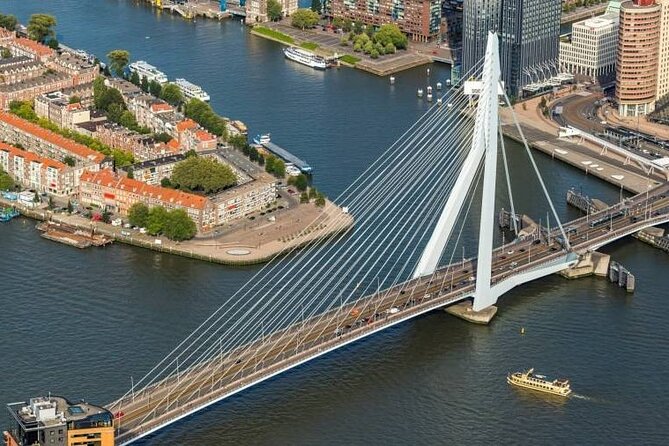
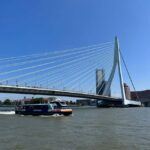
After that you reach Erasmus Bridge, one of Rotterdam’s signature bridges across the New Meuse. It’s often called the Swan or the Harp, and the description includes a specific, useful scale: 139m high and an opening span of 80m that’s described as the biggest and heaviest opening part of a bridge in Europe. It’s the kind of structure that makes you understand why Rotterdam has a global reputation for bold engineering.
The stop here is about 30 minutes, which is generous compared to several other sites. Use it to find a viewing angle rather than trying to take pictures from exactly where you stop.
Kinderdijk windmills: the 3-hour payoff and the one extra ticket you must plan for
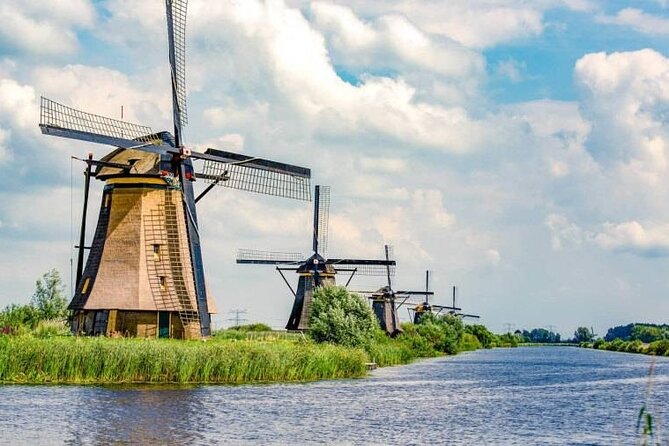
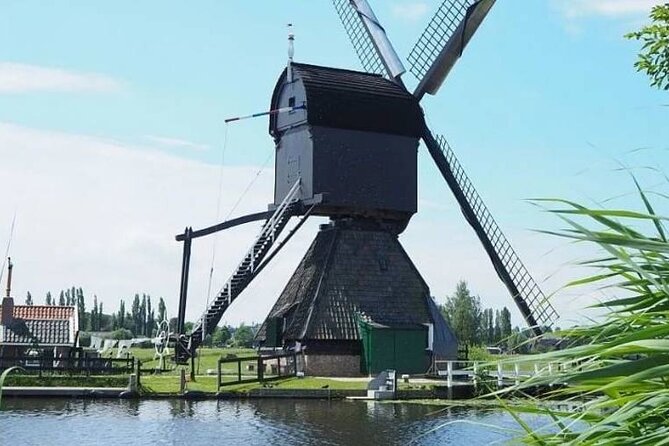
Then you head to Kinderdijk, about 25 km from Rotterdam. The tour gives you around 3 hours there. Kinderdijk is known for 19 unique and authentic polder windmills from the first half of the 18th century, and it’s framed as the best example of Dutch water management working over the centuries.
This is the moment where the whole Rotterdam theme clicks. In Rotterdam, you saw the idea of water policy and river crossings. At Kinderdijk, you see the tool kit: windmills built to manage water levels and keep land usable.
A couple practical notes that help you make the most of those 3 hours:
- Wear shoes that handle walking paths. This is a full outing, not a quick photo stop.
- Bring a little patience for the flow of people on site, even if the tour structure keeps things orderly.
- Since it is 20 minutes to the last bridge stop and then a bus ride, you’ll want to be ready for a transition from city energy to countryside viewing mode.
Important cost note: Kinderdijk admission is €19 per person and is not included. Plan for that before you arrive so you do not feel rushed at the gates.
The included snack and coffee break: small comfort, big pacing effect
One inclusion I genuinely like is the patatje oorlog snack, plus coffee and/or tea. You can think of it as more than food. It’s a pacing tool. When a day is structured around walking and short stops, a planned break helps you keep your legs fresh and your attention sharp.
The tour does not promise a long lunch sitting indoors. Instead, it builds in enough food support to keep your energy stable. If you’re the type who gets cranky when you are hungry, this part matters.
What you will notice most with Alex as your guide
One standout detail from how this tour is run: the guide focuses on linking facts to what you can see around you. Alex is specifically praised for pointing out sites and connecting them with Rotterdam and Kinderdijk history.
Even if you already know the windmill basics, you’ll likely learn the kind of detail that makes a stop feel different, like why older buildings survived major events, why engineering choices show up in architecture, or why bridges and memorials belong in the same visual conversation.
It’s also a small group day. That means you can ask questions without waiting your turn for half an hour.
Who this tour is best for, and who should think twice
This tour is a great match if you:
- Want a guided day through Rotterdam’s most recognizable landmarks
- Like the mix of city sights and a larger countryside stop at Kinderdijk
- Prefer a group capped at 4 for a more personal pace
- Will enjoy walking between many short stops instead of spending most time on buses
It’s less ideal if you:
- Have mobility concerns. The format relies on walking through multiple areas, and the stops add up.
- Expect a slow sightseeing pace. The schedule has structure, and you’ll move.
If you’re healthy on your feet and you like seeing how cities work, it should feel satisfying rather than exhausting.
Should you book the Rotterdam and Kinderdijk walking plus boat day?
Book it if you want a well-led, organized day that combines city icons with the polder windmills, and you like having the route planned for you. The value is strongest when you share the group price with up to three other people, because you’re effectively buying guide time plus transportation plus several admissions.
Skip or reconsider if you know you struggle with long stretches of walking, because this is not a sit-down, minimal-walking tour. Also remember to budget the €19 Kinderdijk admission per person so the day stays smooth.
If you’re deciding between winging it alone or booking a guided plan, this tour is the kind that earns its place. You get a clear story from Rotterdam’s water management and bridges to the windmills at Kinderdijk, with just enough time at each stop to actually look.
FAQ
What is the duration of the tour?
The tour runs about 7 hours 40 minutes.
How many people are in the group?
The maximum group size is 4 travelers.
What is the price, and does it cover everyone?
The price is $591.46 per group (up to 4).
Where does the tour start?
The start is at Stationsplein 48, 3013 AJ Rotterdam, Netherlands.
How long do you spend in Kinderdijk?
You have about 3 hours in Kinderdijk.
Is the Kinderdijk ticket included?
No. Kinderdijk admission is €19.00 per person and is not included.
What’s included in the price?
Included are snacks (patatje oorlog), coffee and/or tea, bus transportation tickets from Rotterdam to Kinderdijk and back, entrance fees to Kijk-Kubus buildings, and tour guide services.
Do I need to buy tickets for Kijk-Kubus?
Entrance fees to the Kijk-Kubus buildings are included.
Do I get a mobile ticket?
Yes, the tour uses a mobile ticket.
What is the cancellation policy?
Free cancellation is available up to 24 hours in advance of the experience start time for a full refund.
Also Reviewed Around Rotterdam


Still in Rotterdam? Keep Going
Windmills, Kept Turning
Fresh off the review pile in Rotterdam
- Private tour: Markthal, Cube houses and Rooftop Het Witte Huis
★ 4.5 · 3 reviews - Private transfer Schiphol (AMS) to or from Rotterdam
★ 5.0 · 3 reviews - Private tour from Rotterdam to Windmills of Kinderdijk & Gouda Cheese Experience
★ 5.0 · 3 reviews - Private Transfer from Rotterdam Port to Amsterdam Airport (AMS)
★ 5.0 · 3 reviews - Discover Rotterdam’s most Photogenic Spots with a Local
★ 5.0 · 3 reviews
Windmills & Zaanse Schans, compared.
 ★ 4.4From Amsterdam: Zaanse Schans, Volendam, and Marken Day TripFrom $4315,931 reviews
 ★ 4.6Amsterdam: Zaanse Schans, Edam, Volendam & Marken Bus TourFrom $3215,034 reviews
 ★ 5.0Day Trip to Zaanse Schans, Edam, Volendam and Marken from AmsterdamFrom $455,392 reviews
 ★ 4.4Amsterdam: Guided Zaanse Schans, Windmills & Cheese TourFrom $224,826 reviews
 ★ 4.0Windmill Tour from Amsterdam, Including Volendam & MarkenFrom $374,572 reviews
 ★ 4.8From Amsterdam: Zaanse Schans, Edam, & Marken Full-Day TripFrom $353,414 reviews
 ★ 4.5Amsterdam: Tour to Keukenhof Gardens with Windmill CruiseFrom $642,819 reviews
 ★ 4.5Zaanse Schans Windmills, Clogs and Dutch Cheese Small-Group Tour from AmsterdamFrom $512,369 reviews
Browse the lists this tour appears in