
REVIEW · AMSTERDAM
Amsterdam Pedicab City Tour (2 hours)
Two wheels beat two feet in Amsterdam. This private, eco-friendly pedicab tour helps you cover major sights with less fuss, guided by Bram de Haan and framed with old photos and maps.
I especially love the private attention, with time to stop for pictures or ask questions, and the way Bram explains Amsterdam through real place stories and comparison photos. You get more meaning per minute than you do on typical hop-on rides.
One trade-off: it is fast-paced. Most stops are quick looks from the street, and museum entries like Rembrandt House Museum are not included.
In This Review
- Key highlights to know before you go
- Why an Amsterdam pedicab beats the walking crush
- Price and logistics: what you really pay for at $237.65
- Meet Bram de Haan, then let the city roll by
- Stop by stop: Dam Square to the Museumplein back view
- Dam Square, where Amsterdam’s story begins
- Zeedijk, old tavern vibes and a darker edge
- Chinatown, Amsterdam’s oldest European Chinese neighborhood
- Nieuwmarkt, the old citygate in the open air
- Montelbaanstoren, the ship-watch tower view
- Rembrandt’s house, outside only
- Jodenbuurt, surviving streets after WWII destruction
- Portuguese Synagogue of Amsterdam, seen from the outside
- National Holocaust Names Monument, brief pass, heavy impact
- H’ART Museum, Hermitage ties along the canal world
- Magere Brug, skinny bridge and postcard lighting
- Canal Ring (Grachtengordel), the famous half-circle pattern
- Museumplein, classic “big museum cluster” views
- How the timing really feels in a 2-hour ride
- Comfort, flexibility, and a realistic expectation of walking
- Who should book this Amsterdam pedicab tour
- Should you book it?
- FAQ
- How long is the Amsterdam Pedicab City Tour?
- How much does it cost, and how many people can ride?
- Is hotel pickup included?
- Is the tour in English?
- Are museum tickets or snacks included?
- What happens if the weather is poor?
Key highlights to know before you go
- Private pedicab for up to 2 people, so the route feels tailored to your questions and pacing
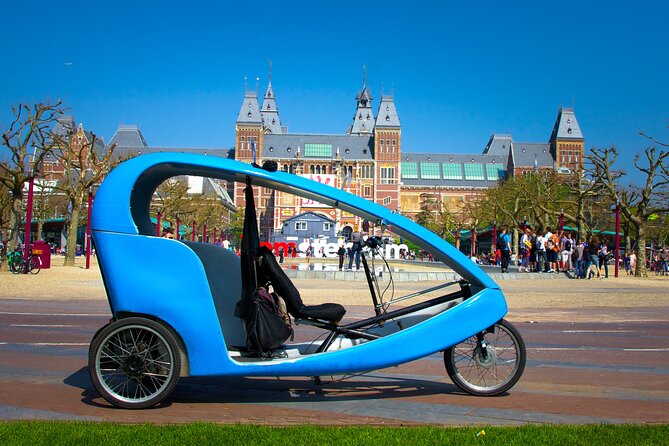
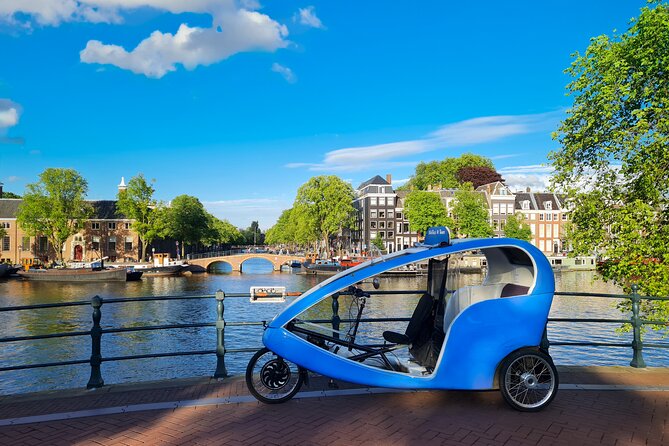
- Hotel pickup with a clear meet-up, look for the blue pedicab out front
- Bram de Haan’s photo and map comparisons, showing how neighborhoods changed over time
- Focused old-center route, covering squares, canals, bridges, and the Jewish quarter
- Rain-ready planning, with waterproof protection when weather turns
- Short street stops, ideal for orientation, not ideal if you want long museum time
Two wheels, no pedalling. More rides around Amsterdam
- Segway City Tours Amsterdam★ 5.0 · 280 reviews
- Amsterdam: Private Guided City Tour by Pedicab★ 4.9 · 130 reviews
- Zaanse Schans: Windmills, Clogs & Cheese by Electric Scooter★ 4.9 · 102 reviews
- Amsterdam: 2-Hour Sightseeing Tour by Rickshaw★ 4.7 · 81 reviews
Why an Amsterdam pedicab beats the walking crush
Amsterdam can be gorgeous and exhausting in the same hour. Streets are narrow, the canal bends trick your sense of direction, and crowds can slow you down when you want to see a lot quickly. A private pedicab city tour fixes the main problem, you move efficiently with minimal legwork while still seeing real streets up close.
The big win is attention. With a private guide, you are not stuck with the group pace or listening from a distance. Bram de Haan can pull over when you want a photo, slow down when you are curious, and connect what you are seeing to what Amsterdam used to look like.
The second win is angle. Two wheels put you at a better street-level view than a bus, and you can get those classic canal and bridge sightlines without fighting through foot traffic. It is also a practical way to take in multiple districts in one loop, instead of spending your day bouncing between one far-flung area and the next.
Price and logistics: what you really pay for at $237.65
This tour runs about 2 hours and costs $237.65 per group (up to 2 people). That pricing can feel high if you compare it to a standard bus tour, but you are not buying a seat, you are buying private transportation plus one-on-one guiding.
You also get a setup that reduces friction. Pickup is offered and you use a mobile ticket. You wait in front of your hotel and look for the blue pedicab. That might sound small, but it matters on day one when you are still figuring out tram stops and street numbering.
A few practical notes help you budget your expectations:
- Admission is not included for museums. You look from the outside at places like Rembrandt’s house, and you do not get included entry.
- Snacks are not included, so plan on grabbing water or a snack before or after your tour.
- There is a maximum total passenger weight limit of 210 kg, and it is one pedicab per timeslot.
Weather matters too. This experience requires good weather. If it is canceled due to poor conditions, you will be offered a different date or a full refund. In other words, this is not a “we run no matter what” tour.
Meet Bram de Haan, then let the city roll by
Bram de Haan is the name that shows up again and again, and for good reason. In the ride, he does more than name buildings. He uses old maps and photos to show how Amsterdam grew, shifted, and rebuilt itself. That turns a quick photo stop into a mini lesson you can actually remember later.
Comfort is also handled like a real city job, not an afterthought. Reviews mention Bram being early for pickup, and in cold or rainy conditions he provided blankets and waterproof protection so the ride stays comfortable. If you are the type who hates canceling plans over a light drizzle, this kind of prep helps.
One nice touch that comes from a true local approach: the route can reflect what you care about. If you ask a question about a neighborhood, or if you want to spend extra time capturing a bridge angle, Bram can adjust the pacing.
Stop by stop: Dam Square to the Museumplein back view
Your ride is built around the historic core and the areas that most visitors want to connect: royal-era landmarks, canal architecture, bridges, the Jewish quarter, and the Museumplein museum cluster.
Other ways to get the shape of Amsterdam in a morning
Dam Square, where Amsterdam’s story begins
You start at Dam Square, Amsterdam’s main square and the old-center heart. In a short window, you are looking at anchors like the Royal Palace, the Nieuwe Kerk (New Church), and the National Monument area. It is a strong starting point because it gives you a “city center compass” fast.
Drawback to know: this is the kind of stop where you get the big picture, not the deep inside details. If you are hoping for long time to explore the palace grounds or churches, you will need to do that separately.
Zeedijk, old tavern vibes and a darker edge
Next is Zeedijk, one of the oldest dikes around the old center. You see the street’s long-standing character and the kind of historic café interior people talk about, the one with a lived-in, old-time feel.
The way Bram frames it is the fun part, you get a “beauty plus a twist” mindset. It is not just scenic; he connects the area to stories that give it weight beyond its façade.
Short stop warning: it is a quick look. You are not walking Zeedijk for hours, you are getting the history pin dropped in your mind.
Chinatown, Amsterdam’s oldest European Chinese neighborhood
Then you roll into Chinatown, described as the oldest Chinese neighborhood on the European mainland. The streets here feel different from the canal ring, and you see how communities shaped the city in waves, with restaurants, shops, and a temple presence.
This stop works well if you like variety in one loop. You get “classic Amsterdam” and “immigrant Amsterdam” without adding a second day trip.
Again, it is mostly a street-view moment. If you want specific food or market time, plan extra time on your own.
Nieuwmarkt, the old citygate in the open air
At Nieuwmarkt, you are in one of the most important old Amsterdam squares. The big visual is the old citygate, once the main entrance when Amsterdam was a walled, fortified city before the major 17th-century expansion.
This stop gives context. A lot of Amsterdam travel brochures ignore the citygate idea, so you end up walking around the city without realizing what barriers once defined it.
Time is tight at about ten minutes, so you will want to use the time for photos and direction questions, not slow strolling.
Montelbaanstoren, the ship-watch tower view
You then reach Montelbaanstoren, an old watch tower tied to the ships and defenses of early 16th-century Amsterdam. From here, you also get a good outlook over De Oude Waal, with houseboats and 17th-century canal houses as a backdrop.
This is one of those stops where the value is the sightline. From the tower area, you understand how canals were not just decoration, they were part of a working system tied to shipping and defense.
Possible drawback: if the wind is up or it is a cold day, the quick stop duration keeps you from lingering. It is best to treat it as a grab the view and move on moment.
Rembrandt’s house, outside only
You pass the Rembrandt House Museum area and see the original Rembrandt house from the outside, where Rembrandt lived during his successful years. You can optionally enter the museum on your own, but entry is not included in this tour.
This is still worth it, because most people know the name Rembrandt, but not how the city framed his life. Bram’s context helps you see the site as part of a living neighborhood, not just a ticket line.
If you strongly want museum time, budget another half day. This tour is about orientation and storytelling, not museum browsing.
Jodenbuurt, surviving streets after WWII destruction
Next is Jodenbuurt, the old Jewish neighborhood area. A lot of the historic fabric was lost after World War II, but some buildings, synagogues, houses, and street lines survived and remain.
This stop is meaningful because it is not a postcard only. Bram ties the area’s remaining streets and structures to how the neighborhood once functioned, which makes your photo stops feel more respectful and less touristy.
It is also a reminder that the city’s beauty carries complicated layers. If you prefer purely light sightseeing, you might find this segment more reflective than you expected, but it is handled in a time-efficient way.
Portuguese Synagogue of Amsterdam, seen from the outside
At the Portuguese Synagogue of Amsterdam, you get a look at the outside. It is described as the largest synagogue and among the first western European communities allowed to build in the latter half of the 17th century, with the building completed in 1675.
You also see other synagogues opposite the building that now help form the Jewish museum area. It’s a good way to connect architecture to legal and social change.
Same caveat: you are mainly seeing the exterior. If you want to go inside, plan that separately.
National Holocaust Names Monument, brief pass, heavy impact
You pass by the National Holocaust Names Monument, made of 102,000 brick stones with names to remind you of Dutch Jewish victims from World War II. You only have a short moment here, around two minutes.
Short timing does not erase the impact. It is just enough time to absorb what it is and snap a quiet photo if that is your style. If you want to read longer or sit with it, you will need extra time on your own.
H’ART Museum, Hermitage ties along the canal world
You pass the H’ART Museum, and the tour frames it through the lens of the building’s earlier use as a major home for a widow care institution in the 17th century. It is part of the Russian Hermitage Museum concept today.
This is a good “in passing but still informative” stop. It reminds you that Amsterdam reuses buildings, and that what you see today often has older purposes behind it.
Magere Brug, skinny bridge and postcard lighting
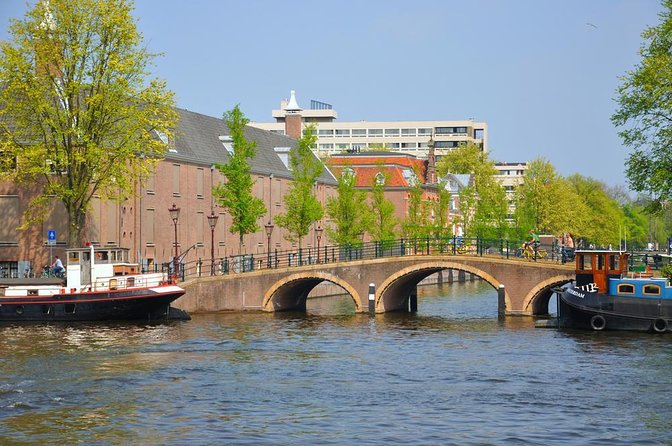
Then comes Magere Brug, the skinny bridge that lights up beautifully at night when hundreds of bulbs accent the design. From the bridge, you get a good overview over the Amstel River, one of Amsterdam’s main canals.
This is a photo-friendly moment. Even during daylight, it helps you connect canal geometry and bridge placement, the two things that make Amsterdam look like a painting.
Drawback: it is brief, about five minutes. If you want the best bridge shots, be ready to move quickly when the stop happens and bring your phone camera settings ready.
Canal Ring (Grachtengordel), the famous half-circle pattern
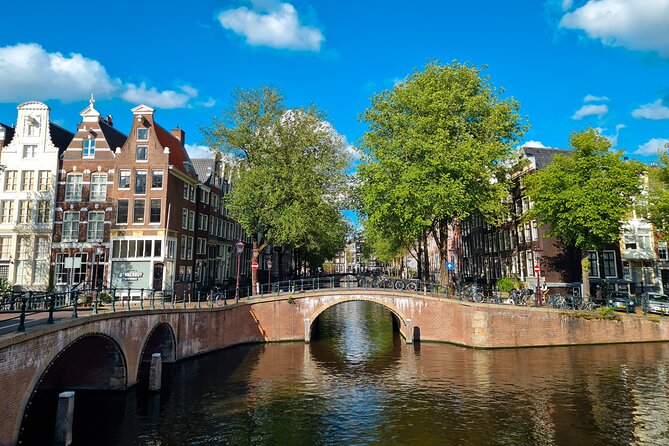
Next is the Canal Ring (Grachtengordel), the 17th-century expansion area that forms half-circle canal arcs around the center. Here you see the typical canal houses that were merchant homes, with differences that show the era and building style rather than cookie-cutter sameness.
This segment is where Bram’s comparisons really help. When you understand what the canal ring represents, every bend and façade starts to make sense. You also learn what looks similar and what signals different periods.
You only get about ten minutes, so focus on noticing building patterns and asking questions while you are moving. This is not the time to hunt for a single perfect façade.
Museumplein, classic “big museum cluster” views
Finally, you reach Museumplein, Amsterdam’s big museum square. One side is the Rijksmuseum, plus the Concertgebouw on the other. Next to the square are spots like the Van Gogh museum, Stedelijk museum, Moco museum, and even the Diamond Museum.
You do not need a museum ticket to enjoy the square. It is open space, and it gives you the scale of Amsterdam’s cultural priorities.
A standout detail is the ride through the bicycle tunnel under the Rijksmuseum. The tour notes that street artists’ classical music can sometimes be heard there. It is a weirdly perfect Amsterdam moment, bike culture plus art sound plus architecture all at once.
You also end with a strong view of the back of the Rijksmuseum, completed in 1885, designed by the Catholic architect Pierre Cuypers. That back view is often missed by people walking straight to the entrance.
How the timing really feels in a 2-hour ride
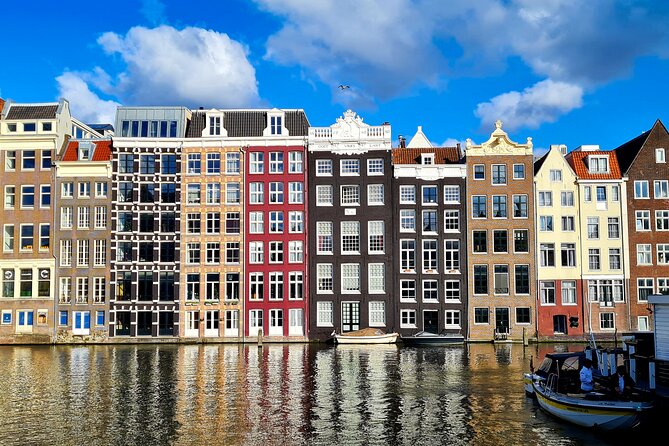
Because this is about covering a broad area, stops are generally short, often 5 to 10 minutes. You get enough time to orient yourself, read the key context, and take photos, but not enough for long wandering.
That works in your favor if you want an intro day. If you only have a day or two in Amsterdam, this kind of route can save you from spending your limited time zigzagging across districts.
It can be limiting if you have a deep interest in one location. For example, the tour looks at Rembrandt’s house from outside and passes important memorials in brief moments. If you want prolonged museum time or longer memorial reading, this tour should be the start of your sightseeing, not the final stop.
Comfort, flexibility, and a realistic expectation of walking
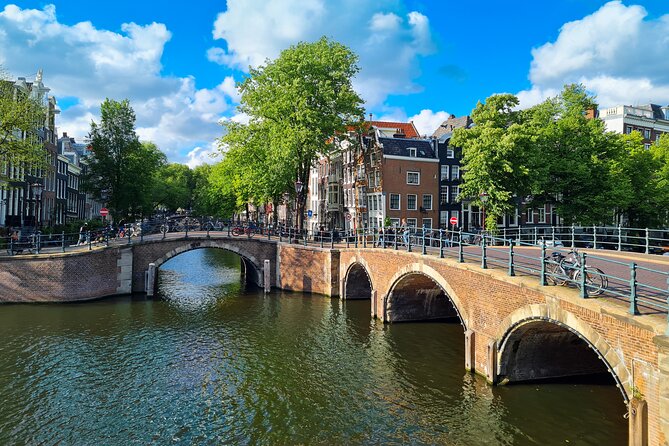
The pedicab layout is designed for easy on and off, and the maximum passenger limit and total weight cap matter for safety and comfort. In practice, this ride is ideal for two people who want to see a lot without doing the “all day, all walking” routine.
The flexibility is part of why people love it. When weather turns, the tour is set up with waterproof protection. When you want pictures, Bram can pull over. And if something on the route catches your interest, he can steer the story to match.
There is also a practical side to the guiding. One review notes Bram directing people toward nearby groceries and helping with directions back afterward. That is the kind of local help that feels small, then saves you time later.
Who should book this Amsterdam pedicab tour
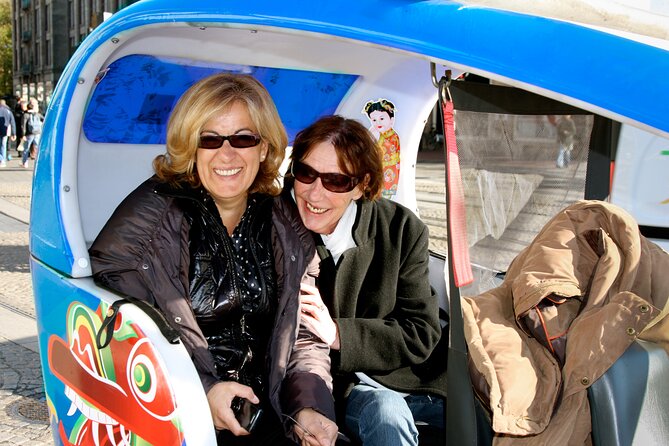
You will likely love this tour if you:
- Want an intro loop across multiple neighborhoods in about two hours
- Prefer less walking but still want street-level views and good photos
- Enjoy history told as stories tied to specific corners, squares, and buildings
- Travel as a couple or small group of up to two and want true private guiding
You might want to skip or adjust expectations if you:
- Want included museum tickets or long interior time at Rembrandt’s house or synagogues
- Are planning a day where you want to do only one area slowly, like a full-day canal cruise plus museum visits
Should you book it?
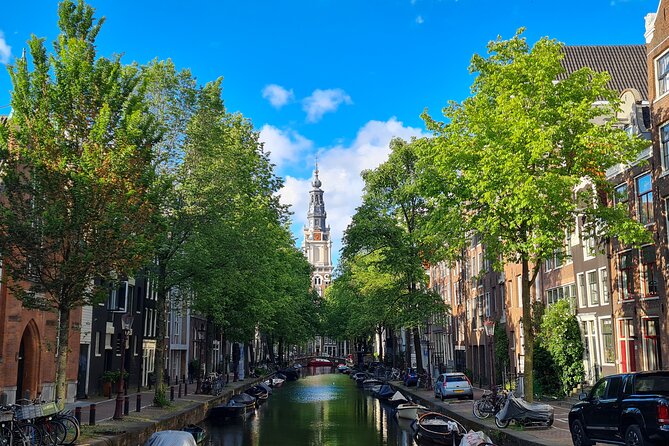
If your goal is seeing Amsterdam fast, with context, I think this is an excellent buy. The price works because you pay for a private guide, a ride that keeps you moving, pickup convenience, and a storytelling style that uses old maps and photos to make the city’s changes click.
Book it especially if it is one of your first stops in town or you are trying to sort out where everything fits. It is also a smart choice if you want to avoid the walking grind while still understanding the city.
If the weather looks questionable, do it anyway only if you are okay with the possibility of a date change or refund. When conditions are good, this tour is an efficient way to get your bearings fast and still feel like you learned something real.
FAQ
How long is the Amsterdam Pedicab City Tour?
The tour runs about 2 hours.
How much does it cost, and how many people can ride?
It costs $237.65 per group, for up to 2 people.
Is hotel pickup included?
Yes, pickup is offered. You wait in front of your hotel and look for the blue pedicab.
Is the tour in English?
Yes, it is offered in English.
Are museum tickets or snacks included?
Museum entries are not included, and snacks are not included.
What happens if the weather is poor?
This experience requires good weather. If it is canceled due to poor weather, you will be offered a different date or a full refund.
Everything Else From Our Amsterdam Notebook




Also Reviewed Around Amsterdam




Rolling Through Amsterdam Without Pedalling





Fresh off the review pile in Amsterdam
- Full-Day Trip From Amsterdam to Keukenhof, Zaanse Schans + Cruise
★ 5.0 · 3 reviews - Boutique Dutch Food & History Tour with up to 8 guests only
★ 5.0 · 3 reviews - Private Tour to Windmills Zaanse Schans +Keukenhof – 7 Hours
★ 5.0 · 3 reviews - Full-Day Private Guided Countryside Tour from Amsterdam by Bike
★ 5.0 · 3 reviews - Amsterdam Red Light District and Old Town Walking Tour
★ 5.0 · 3 reviews
City Tours, compared.
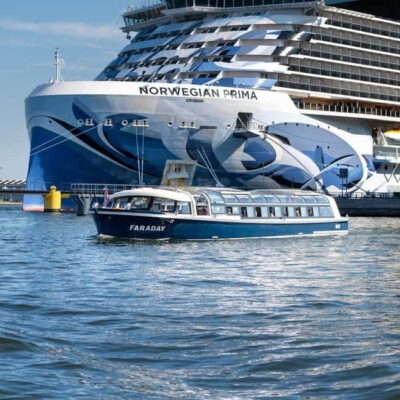 ★ 4.4Amsterdam: 75 Minute City Canal Cruise with Audio GuideFrom $1717,501 reviews
 ★ 4.2Amsterdam: City Centre Canal CruiseFrom $1812,827 reviews
 ★ 4.7Amsterdam: Smoke and Lounge City Boat CruiseFrom $278,572 reviews
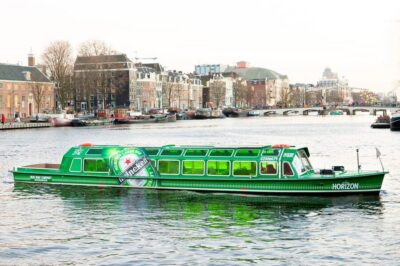 ★ 4.5Amsterdam: City Canal Cruise and Heineken Experience TicketFrom $475,367 reviews
 ★ 4.7Amsterdam: Guided Bike Tour City Centre in EN/DE/FR/ESFrom $414,187 reviews
 ★ 4.6Amsterdam: Van Gogh Museum Ticket and City Canal CruiseFrom $473,899 reviews
 ★ 4.4Amsterdam: City Canal Cruise and Heineken ExperienceFrom $443,133 reviews
 ★ 4.3Utrecht: City Canal CruiseFrom $222,895 reviews
Browse the lists this tour appears in