
REVIEW · AMSTERDAM
Amsterdam: Red Light District Walking Tour
Red drapes, old canals, and sharp stories. This 2-hour Amsterdam walk through the Red Light District and Old Town is interesting because the guide ties what you see to how the neighborhood has changed over time. I like the way the local guide keeps the conversation grounded in both past and present issues, including the more recent controversies.
I also like the route mix, from Zeedijk Street’s older sailor feel to Chinatown’s street life, then on to the historic Nieuwmarkt area. One possible drawback to consider: the topic is adult and the sights are direct, so if you want a low-key, kid-friendly stroll, this one might not match your comfort level.
In This Review
- Key things you will notice on this Amsterdam walking tour
- A 2-hour route that fits Amsterdam walking reality
- Zeedijk Street: old sailor neighborhood mood and quick street orientation
- Chinatown and the Nieuwmarkt area: history, food stops, and canal-side angles
- In’t Aepjen, crooked houses, and the kind of Amsterdam you rarely plan for
- The Red Light District center: windows, red drapes, Cassa Rosso, peep shows, and Bananenbar
- Why sex work is legal here, and the coffeeshop name story
- Guide energy: what it feels like when the storytelling actually works
- Price and value: what you get for $33 in 2 hours
- Practical tips so the walk stays enjoyable
- Should you book this Amsterdam Red Light District walking tour?
- FAQ
- How long is the Amsterdam Red Light District walking tour?
- What is the price per person?
- What does the tour include?
- Is transportation included?
- What languages are the live guides speaking?
- Where is the meeting point?
- Can I book and change my plans?
Key things you will notice on this Amsterdam walking tour
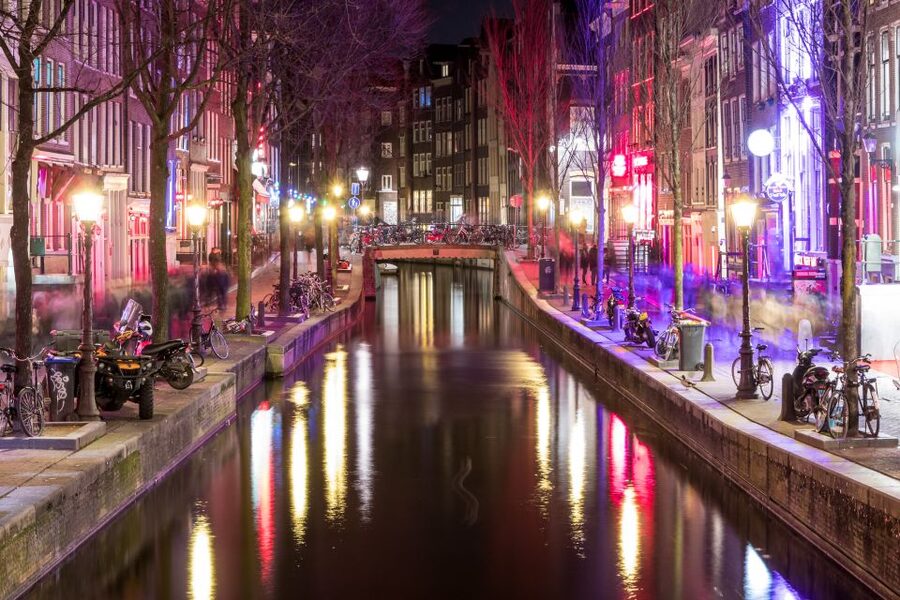
- Zeedijk Street sets the tone with an old sailor neighborhood vibe before you head into newer-feeling streets
- Chinatown shifts the mood, including a story about how an unsafe area became a friendlier one
- Nieuwmarkt Square and the Waag show Amsterdam’s layered past, where a city gate now works as a restaurant
- Red Light District sights are concrete: prostitution windows with red drapes, plus spots like Cassa Rosso and peep shows
- Sex-work legalization and the coffeeshop name come up with an explanation from your guide, not just pointing at storefronts
- Guides stay lively. Names like Ari, Aaron, Robin Van Gemer, and Sander show up in feedback for being upbeat and informative
Other guided walks through this part of Amsterdam, for adults
- Amsterdam: Red Light Secrets Museum Entry Ticket★ 4.2 · 5,722 reviews
- Amsterdam: Red Light District Tour in German/English/Italian★ 4.9 · 5,623 reviews
- Amsterdam Red Light District & Coffee Shop Tour★ 4.6 · 4,134 reviews
- Amsterdam: Red Light District Pub Crawl with Unlimited Shots★ 4.1 · 2,130 reviews
A 2-hour route that fits Amsterdam walking reality
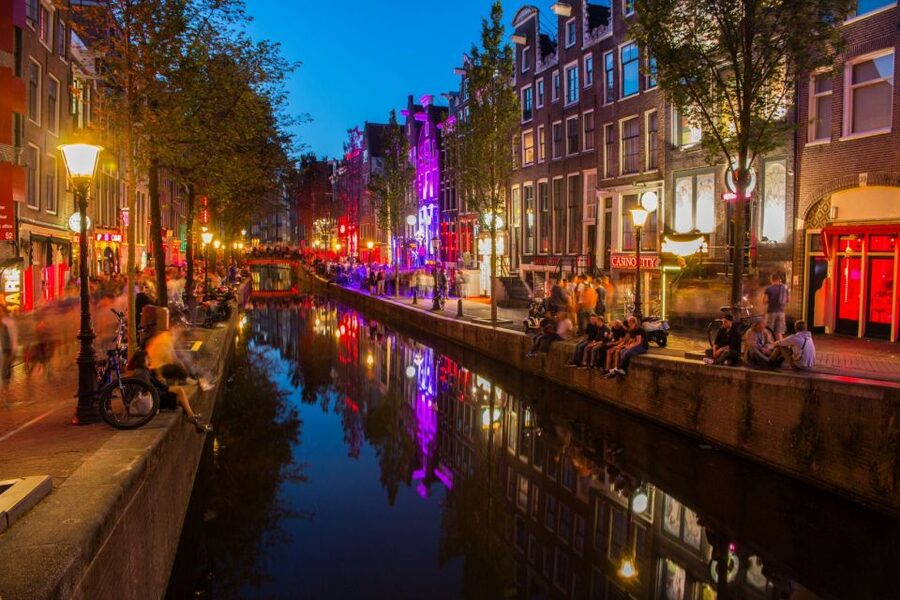
This is a tight 2-hour walk, priced at $33 per person, built for seeing a lot without getting trapped in long transit loops. Since transportation is not included, you are doing this as a true walking experience. That matters because Amsterdam’s charm is in the narrow lanes, the sightlines, and the way streets curve around canals. The timing also means you are getting context while the neighborhood is still in front of you, not after you have drifted away.
Meeting point can vary depending on the option you book, so check your specific confirmation. Language is English or German, and the tour is led by a live guide, which is the key ingredient here. You are not just “looking at buildings.” You are learning why these streets look the way they do and how laws changed what the city permits.
Zeedijk Street: old sailor neighborhood mood and quick street orientation
Your walk begins around Zeedijk Street, described as an old sailor neighborhood. That is a smart way to start, because it gives you a baseline for what Amsterdam feels like when you step away from the biggest postcard corners. Expect narrow streets and the kind of tight layout where you keep noticing details at your shoulder level.
I like how this start helps you get oriented fast. Before you reach the most famous adult zone, you already have a mental map of the city’s older street pattern. It makes the later sections feel less like a shock and more like a neighborhood with layers.
Also, the guide’s storytelling is part of why this works. The tour is set up so you understand that the Red Light District did not appear out of nowhere. It grew through the city’s shifting population, economy, and politics. Starting in Zeedijk Street helps you understand the “before” that people miss when they only arrive for window-shopping.
Chinatown and the Nieuwmarkt area: history, food stops, and canal-side angles
From Zeedijk Street, you move into Amsterdam’s Chinatown, including a guided walk through streets with Chinese shops. The tour also gives you the backstory that this area used to be unsafe and later became more friendly. That kind of change is important because it challenges the idea that neighborhoods stay frozen. Cities rebrand themselves through policing, businesses, and community pressure.
You will also see landmarks tied to the older Amsterdam feel. Crooked homes and canal-adjacent views are part of the experience, and the tour uses these visuals to explain how the city’s design has shaped daily life. This is where “Red Light District” stops being the only headline and turns into one chapter in a much bigger book.
Next comes Nieuwmarkt Square, a practical and scenic pause point. The Waag is a highlight here. It originally served as a city gate and is now a restaurant. Even if you do not plan to eat there, it is a powerful example of reuse in a historic city: the structure remains, but the purpose updates.
If you want a snack, you stop near market stalls. This is a small thing, but it keeps the pace realistic. Two hours goes by quickly when you are walking, listening, and taking in dense urban detail.
In’t Aepjen, crooked houses, and the kind of Amsterdam you rarely plan for
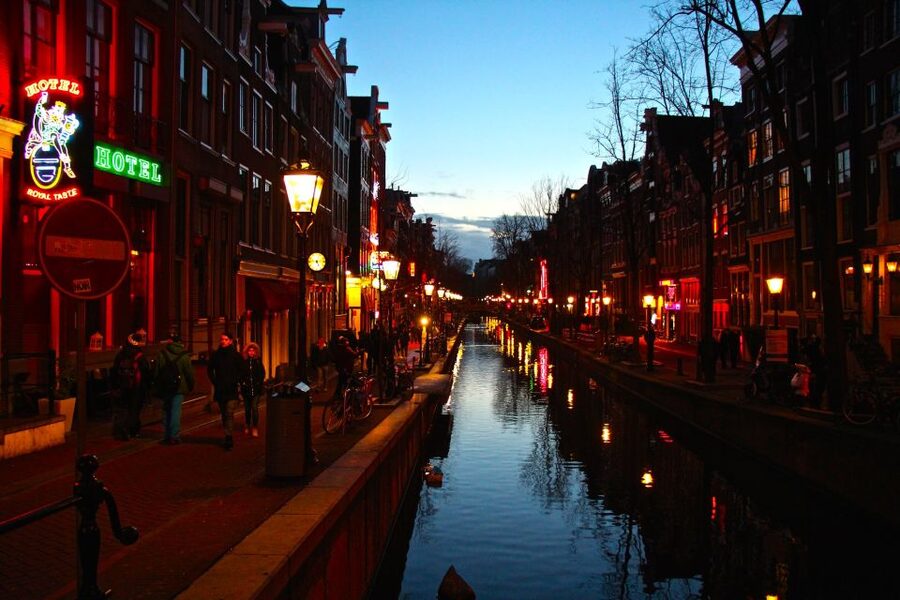
One of the most interesting parts of this tour is that it does not keep you only on the famous adult sights. You also get sidesteps that highlight Amsterdam’s older texture, including a stop at In’t Aepjen. This is the sort of place that helps you understand why Amsterdam still feels lived-in, not staged.
You also catch glimpses of crooked house facades along the route, the kind of wonky angles that look charming and also hint at real constraints from earlier building eras. I like that the guide points out what you are seeing instead of letting you guess. You end up noticing more, even when you are just passing.
If you prefer tours that feel like a city walk rather than a checklist, this section is where you will feel it most.
Prefer to see it on foot? More Amsterdam walks


The Red Light District center: windows, red drapes, Cassa Rosso, peep shows, and Bananenbar
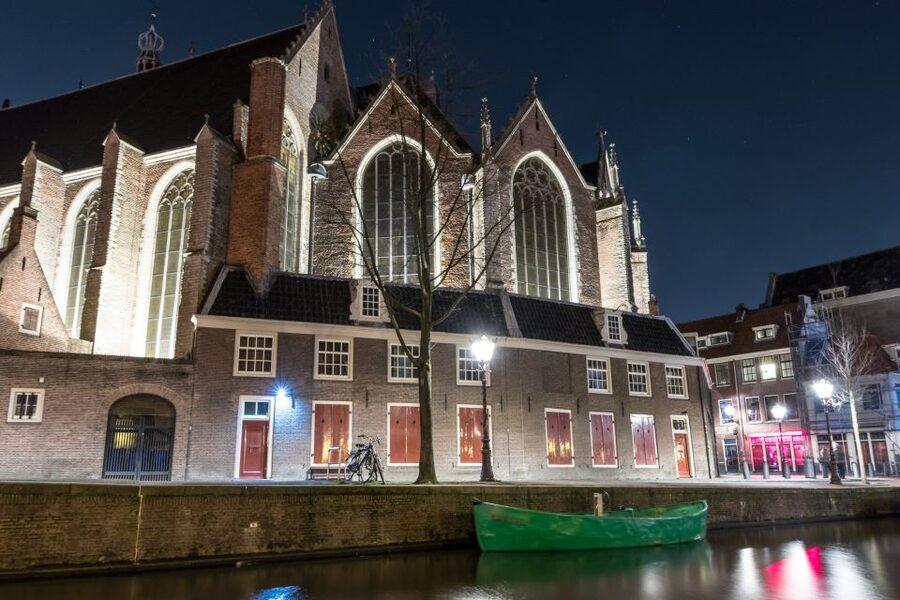
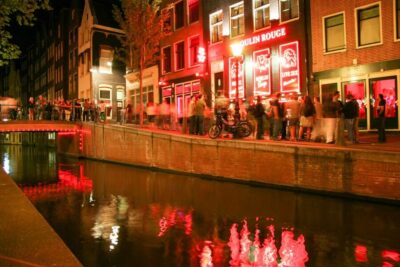
Now you reach the center of the Red Light District, where the sights are unmistakable. You will see prostitution windows lined with red drapes, and you will learn about why these spots exist in Amsterdam today.
The guide also helps you connect key locations to the broader story. Highlights include:
- Cassa Rosso, a prominent location tied to the district’s current identity
- peep shows, which represent the entertainment side of the strip
- Bananenbar, another named stop that anchors the walk in real storefronts
- strip-club type venues in the surrounding area (the tour frames these as part of how the neighborhood operates)
This is the part of the tour where respect matters. You are watching a legal industry in a public space, so you do not need to stare like it is theater, and you also do not need to pretend it is not happening. The guide’s job is to give you context, not to make you uncomfortable. Still, the material is adult. If you are sensitive to that, consider whether a walking tour that includes explicit storefronts is the right choice.
I find that the best mindset is curiosity with boundaries. Let the guide explain what you are seeing, and keep your focus on the street-level details and the history. That is how the walk turns from shock into understanding.
Why sex work is legal here, and the coffeeshop name story
One of the most valuable parts of the tour is the legal and cultural explanation. The guide covers why prostitution was legalized in the Netherlands and how that legal approach shaped the district’s present-day form.
This is not just trivia. It answers a question most visitors have but rarely hear clearly: why is this allowed here, openly? When you understand the legal framework, you can interpret the storefront design, the public visibility, and even the district’s ongoing debates with more clarity. You are seeing policy play out in city space.
The tour also includes an explanation of how the term coffeeshop was coined. Even if you have heard the word used differently, the explanation helps you connect local language to local history. It is one of those details that makes the tour feel like real Amsterdam and not a tourist-only script.
The guide also brings up more recent controversies. You will get a sense that this is not just a static tradition, but an issue that continues to evolve, socially and politically.
Guide energy: what it feels like when the storytelling actually works
The difference between a forgettable walk and a memorable one is the guide. Here, the names Ari, Aaron, Robin Van Gemer, and Sander are mentioned in feedback for a reason: the tour style is described as upbeat, engaging, and informative. You can feel that in the pacing. The guide keeps the group moving while keeping the stories connected to the streets.
Language support is a plus if you want a smoother experience. English and German are offered, so you do not have to rely on your best guess at local context. Private group availability is also useful if you want a more tailored pace and discussion style.
If you do not love long lectures, you will probably appreciate this setup. The learning is anchored to stops like Zeedijk Street, Chinatown, Nieuwmarkt Square, Waag, and the named Red Light District locations. That keeps the information practical.
Price and value: what you get for $33 in 2 hours
At $33 per person, this is not a “cheap and cheerful” add-on, but it also is not overpriced for what you get. You are paying for two big things: a local guide and a concentrated route through several districts that most people only see in pieces.
For value, ask yourself what you would do without the guide. You would likely wander the streets, take in window displays, and maybe read a bit later. What the guide adds is interpretation. You learn the district’s evolution, the legalization angle, and the meaning behind the major stops like Cassa Rosso and the Waag.
In other words, the money goes toward context, not just access. For a city like Amsterdam, where streets overlap and history is dense, that context saves time and reduces confusion.
Practical tips so the walk stays enjoyable
This tour is most enjoyable when you set expectations. You are walking through an adult district where parts of everyday commerce are visible from the street. I recommend you:
- Wear comfortable shoes. This is a walking tour with no included transportation.
- Keep your phone use discreet. Focus on what the guide is explaining, especially around the named stops.
- If adult content makes you uneasy, decide before you start. The route includes prostitution windows and peep-show culture.
- Bring a simple mindset: ask how and why, not just what.
Also, Amsterdam is famous for being walkable, but weather can change fast. Since the tour is short, you may want a light layer just in case.
Should you book this Amsterdam Red Light District walking tour?
Book it if you want a guided walk that connects Red Light District sights with the legal and cultural story behind them. It is a good fit if you enjoy city walking, like Old Town details such as crooked homes and canal views, and want a clear explanation of how legalization shaped what you see.
Skip it if you want an atmosphere-free stroll, or if you prefer not to experience adult storefronts and explicit window displays. The tour is direct by design. It is not trying to sanitize the neighborhood.
One more note on timing and flexibility: you can cancel up to 24 hours in advance for a full refund, and you can reserve first and pay later. That makes it easier to plug into a busy Amsterdam schedule.
If you are curious, respectful, and ready to listen to a real local explanation, this is one of the more focused ways to understand a place many visitors only half understand.
FAQ
How long is the Amsterdam Red Light District walking tour?
The tour lasts 2 hours.
What is the price per person?
The price is $33 per person.
What does the tour include?
It includes a local guide and a walking tour.
Is transportation included?
No, transportation is not included.
What languages are the live guides speaking?
The tour is available with live guides in English and German.
Where is the meeting point?
The meeting point may vary depending on the option booked.
Can I book and change my plans?
You can reserve now and pay later, and you can cancel up to 24 hours in advance for a full refund.
Everything Else From Our Amsterdam Notebook





Also Reviewed Around Amsterdam





The Adult Side of Amsterdam, Explained




Fresh off the review pile in Amsterdam
- Full-Day Trip From Amsterdam to Keukenhof, Zaanse Schans + Cruise
★ 5.0 · 3 reviews - Boutique Dutch Food & History Tour with up to 8 guests only
★ 5.0 · 3 reviews - Private Tour to Windmills Zaanse Schans +Keukenhof – 7 Hours
★ 5.0 · 3 reviews - Full-Day Private Guided Countryside Tour from Amsterdam by Bike
★ 5.0 · 3 reviews - Amsterdam Red Light District and Old Town Walking Tour
★ 5.0 · 3 reviews
Red Light District & Coffeeshops, compared.
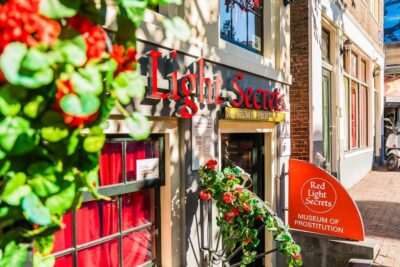 ★ 4.2Amsterdam: Red Light Secrets Museum Entry TicketFrom $175,722 reviews
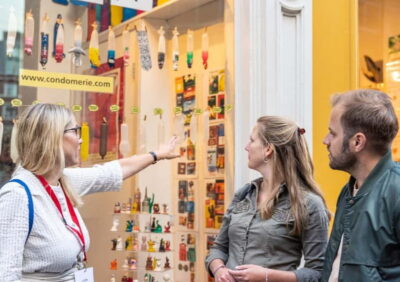 ★ 4.9Amsterdam: Red Light District Tour in German/English/ItalianFrom $285,623 reviews
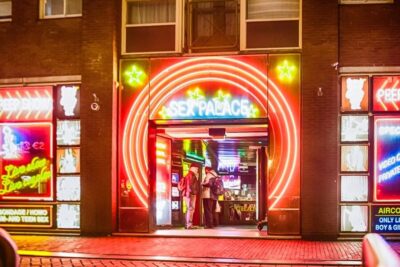 ★ 4.6Amsterdam Red Light District & Coffee Shop TourFrom $294,134 reviews
 ★ 4.1Amsterdam: Red Light District Pub Crawl with Unlimited ShotsFrom $242,130 reviews
 ★ 4.5Amsterdam Red Light District Pub CrawlFrom $241,497 reviews
 ★ 4.2Amsterdam: Cannabis Museum Entry TicketFrom $141,244 reviews
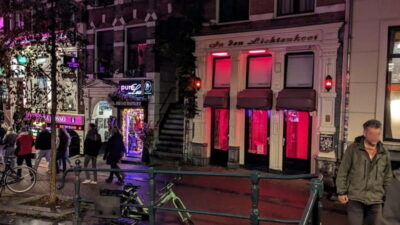 ★ 4.5Amsterdam: Red Light District TourFrom $331,135 reviews
 ★ 4.1Amsterdam: After Dark Red Light District TourFrom $571,030 reviews
Browse the lists this tour appears in