

REVIEW · GRONINGEN & THE NORTH
e-Scavenger hunt Deventer: Explore the city at your own pace
Turn Deventer into a game trail. You get a smartphone city trail in Deventer that plays like a scavenger hunt, with self-guided stops and a 24/7 start window.
I like that it is built for groups, up to 6 people, and the rules encourage you to think your way through the streets for the best score. I also like that it keeps you moving with quick challenges while you see major landmarks in a practical walking loop.
One consideration is simple: the trail needs your own smartphone and data, and you are playing it on your own without a live guide steering the story.
In This Review
- Key highlights at a glance
- A Deventer trail you can start any day, any time
- Why the scoring and leaderboard change the experience
- Price and value: what $37.21 per group really buys
- Where you start in Deventer, and how to plan your 3-hour loop
- How the Qula City Trail works on your phone
- Stop-by-stop route: 12 Deventer landmarks in one hunt
- 1) Speelgoedmuseum Deventer
- 2) Deventer
- 3) Stadhuis van Deventer
- 4) Broederenkerk
- 5) Lebuinuskerk
- 6) Toren Grote of Lebuinuskerk
- 7) De Brink
- 8) Bergkerk
- 9) Wilhelminafontein
- 10) Walstraat Deventer
- 11) De Proosdij
- 12) Synagoge
- Who this Deventer e-Scavenger hunt suits best
- What to bring, and how to keep it smooth
- Booking timing and day-to-day logistics that matter
- Should you book the e-Scavenger hunt Deventer?
- FAQ
- How many people can play the e-Scavenger hunt Deventer?
- How long does the Deventer City Trail take?
- Do I need to book a specific start time?
- Where does the trail start and end?
- What languages are available?
- Is a smartphone and data included?
- What is the cancellation policy?
Key highlights at a glance
- Up to 6 players per group, so friends and family can stay together
- Leaderboard scoring that adds motivation beyond just sightseeing
- No fixed start times, no time limit, start when you want and take breaks
- Smartphone-based Qula City Trail, with emailed instructions before you go
- Major Deventer landmarks in one loop, from Speelgoedmuseum Deventer to the Synagoge
- Multiple languages, including English plus German, French, Dutch, Spanish, Italian, and more
More puzzle walks you can start whenever you feel like it
- e-Scavenger hunt Deventer: Explore the city at your own pace★ 4.0 · 34 reviews
- Discover Amerfoort’s city center in this Outside Escape game tour★ 4.5 · 32 reviews
- e-Scavenger hunt Zierikzee: Explore the city at your own pace★ 4.5 · 24 reviews
- e-Scavenger hunt Zwolle: Explore the city at your own pace★ 4.5 · 23 reviews
A Deventer trail you can start any day, any time
This is the kind of activity that fits real travel life. You are not locked into a set departure time, so you can pick a day when the weather looks good or when everyone’s schedules line up.
The trail is available 24/7, and there is no time limit. That means you can take your time at the museums and churches, or pause the hunt if you need coffee, photos, or a restroom break. You can start, pause, and stop whenever it suits you, then pick back up later.
Because it is a phone-driven route, it also works well for travelers who hate rigid itineraries. Instead of a group pace and a guide voice you have to follow, you choose your speed. The trail still pushes you along, but it adapts to you.
Why the scoring and leaderboard change the experience
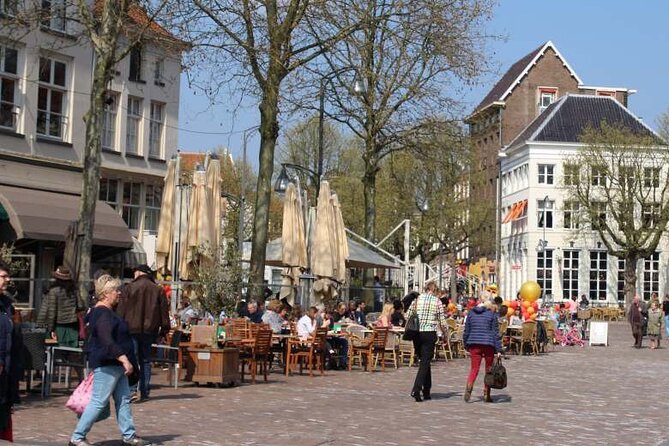
The fun here is not only in reaching a list of sights. Each stop asks you to do something, and the goal is to collect the best points so you can climb the leaderboard.
That scoring system changes the feel from sightseeing to problem solving. You will naturally slow down to read instructions carefully and check answers before you move on. In a good way, it nudges you from passive looking into active noticing.
If you are traveling with family or friends, it also creates an easy game dynamic. One person reads, another hunts for the clue, and someone else checks the final submission. It becomes teamwork without you needing to coordinate a complex format.
Price and value: what $37.21 per group really buys
The price is $37.21 per group, valid for up to 6 people. For many visitors, that pricing model is the key advantage: the cost does not jump dramatically as your group grows.
A useful way to think about value is per person at full capacity. If you have 6 players, you are effectively paying roughly $6 per person for about a 3-hour activity built around a self-guided city route. Even if you have fewer people, it can still be a cost-friendly option compared with paying for multiple separate admissions or private guiding.
You are paying for the trail experience itself, not for museum tickets. So if you want to add extra entry fees at a stop, plan for that separately. Still, for a low-cost, high-walk, smartphone-based outing, the price is easy to justify.
Where you start in Deventer, and how to plan your 3-hour loop

You start and end at Kleine Poot 7, 7411 PE Deventer. That round-trip format matters because it simplifies logistics. You do not have to figure out public transit or a pickup point at the end of the route.
The activity runs about 3 hours (approx.). You will cover the main route in about 2 hours while solving riddles and assignments, with extra time possible depending on how long you linger at each stop or how often you pause.
Because the trail is near public transportation, you can also make this part of a larger day. If you plan to visit more places after the hunt, you know you will be back at your starting area.
The biggest planning tip is battery. A phone that dies mid-route turns a fun puzzle walk into an annoying detour. Charge before you go, and consider using a battery-friendly setting like lower brightness.
North of the rivers, more to do



How the Qula City Trail works on your phone
After you book, you receive an email with instructions for playing the trail on your smartphone. It is compatible with both Android and iPhone, so you should not need a special device.
When you arrive at the starting point, you begin the quest. From there, the trail guides you from stop to stop and prompts you to complete assignments at the landmarks.
The trail is designed to be self-paced, which is a big deal. If your group includes different energy levels, you can move as a team while still choosing how fast to solve each task. If someone needs a break, you do not have to guess where the guide would be. You just pause, then continue.
Do keep in mind that smartphone tech is part of the experience. If you are not comfortable using your phone for directions and mini-challenges, this may feel more like a tech task than a casual walk.
Stop-by-stop route: 12 Deventer landmarks in one hunt
The route is built around 12 named stops. At each one, you are solving something on your phone, so you are not just passing by. You are looking at the place with a mission.
Here is what you will do, and what to watch for at each stop.
1) Speelgoedmuseum Deventer
This is your opening move. Starting with a museum stop can be a nice way to set the tone, since museums tend to reward slow observation and reading. Use this first location to get your bearings and to test your team’s rhythm on the phone tasks.
A small drawback: if you expect a guided story at the museum itself, the trail does not replace that. You are mostly solving trail prompts while you are at the location.
2) Deventer
This stop is broader than the others, and that can be a clue about the trail style. Instead of focusing on one single building name, it may ask you to notice a general area feature.
This is where I’d suggest you slow down rather than rush ahead. When a stop is more general, the answer tends to come from details you would otherwise miss.
3) Stadhuis van Deventer
The town hall stop is often a great mid-trail moment because it gives you something visually strong to focus on. Even if you are not aiming for architectural study, a landmark like this makes it easier to orient yourself.
If your group likes photos, this is likely a good place to take a quick picture first, then return to the riddle. That way you do not end up crowding around the screen while standing in the wrong spot.
4) Broederenkerk
A church stop is usually the best setting for reflective pauses. The trail tasks here can make you look around the surroundings instead of walking straight past.
The consideration: church areas can sometimes have rules about where you can go or how you behave. Keep your group respectful and follow any local signs you see.
5) Lebuinuskerk
This is another major church landmark in the route. With two church stops close together, the trail seems designed to keep the walking loop interesting while still anchored to recognizably important spots.
I recommend you keep your phone use simple here. Read the prompt, look around once, then answer. If you start running in circles, you waste time and energy.
6) Toren Grote of Lebuinuskerk
A tower stop adds vertical interest. Your task at this location likely relies on spotting a specific element tied to the tower.
This is a good spot to be patient. From certain angles you may only see part of what you need. If the clue asks for a detail, try stepping a few meters to get the better view.
7) De Brink
“De Brink” feels like an open, central urban area type of stop, which often makes riddles easier to solve because you can scan more broadly.
If you have the team that loves brainstorming, this is a great time to use it. Open spaces invite more movement, so you can rotate who searches while the others confirm clues.
8) Bergkerk
Another church landmark, with a different name than the earlier stops. Having multiple religious sites on one hunt can be great for variety, as long as you keep your expectations practical: you are doing a game, not a structured guided lecture.
If your group is tired, this is where a pause can help. Use the stop to reset, then continue strong.
9) Wilhelminafontein
A fountain stop can feel like a fun change of pace from churches and civic buildings. Water features often make it easier to notice visual details tied to a clue.
Watch for crowds. If lots of people are around, you might need a short waiting window to read and solve without blocking others.
10) Walstraat Deventer
This is a street-name stop, and that usually means your phone prompts you to focus on the streetscape itself. Streets can be surprisingly important in city trails because clues are often tied to signage, storefront details, or the shape of the street.
My practical tip: do not rely on your memory from earlier streets. Solve using what you see right now, then move on.
11) De Proosdij
This is another named site stop, which suggests the trail is using specific local labels as part of the puzzle path. Named areas help reduce confusion because you know you are “at the right place” even before you read the prompt carefully.
If you are traveling with kids, this kind of identifiable stop usually makes the game feel more achievable, because it is easier to locate than a vague landmark.
12) Synagoge
The final stop lands at the Synagoge. Ending at a place of worship can be meaningful, even if you are mainly focused on finishing the trail and sending in the last answers.
Do keep it respectful and quiet. Also, save a little time here if you want to linger for atmosphere after your final response.
Who this Deventer e-Scavenger hunt suits best
This is ideal for groups of friends and families who want a shared activity without the pressure of syncing with a guide schedule. Since it supports up to 6 people, it also works well for small groups that want a single device experience rather than splitting into different plans.
It is also a strong option for travelers who love walking but dislike walking blindly. The trail structure gives you a reason to take side streets and look closely at each landmark.
Where it might not fit: if you want a live guide explaining stories behind each location, this trail will feel more like a self-directed game. You will learn as you go through the prompts, but the experience is not positioned as a guided talk.
What to bring, and how to keep it smooth

The big “bring your own” item is your smartphone and data. The trail includes the city trail experience for your group, but it does not include a phone or connectivity.
So before you set off:
- Make sure your phone is charged
- Have enough mobile data for the route and prompts
- Keep your sound on if the prompts include audio, since you are playing assignments as you go
Comfort-wise, the trail is described as user-friendly for hearing impaired travelers, and service animals are allowed. If mobility is a concern, you will want to treat it as a walking route around central Deventer, and pace yourself based on your group.
Booking timing and day-to-day logistics that matter

This is available on a rolling schedule, and you can start on the day and time you choose. That reduces stress for travelers who do not want to lock their entire day around an activity.
It is also easy to plan because the route returns you to the starting point. That makes it simpler to connect with other plans after the hunt, whether that is dinner, a second museum stop, or just a long sit-down.
If you like having options, booking around two weeks in advance is typical, based on average booking timing. With free cancellation up to 24 hours before the start time, you can also keep flexibility if your schedule is still shifting.
Should you book the e-Scavenger hunt Deventer?
Book it if you want a self-paced way to see Deventer’s main landmarks while turning the walk into a friendly competition. The pricing per group is a real advantage, especially when you can fill up to 6 spots, and the no-time-limit setup makes it forgiving for real-life travel interruptions.
Skip it or think twice if you dislike smartphone-based activities, or if your group would rather have a live guide telling stories. Also, if you are traveling without a reliable phone plan, the lack of included smartphone and data can be a deal-breaker.
If you want an affordable, structured city walk with built-in game energy, this Qula Deventer City Trail is a solid match.
FAQ
How many people can play the e-Scavenger hunt Deventer?
The trail is for a team of up to 6 people.
How long does the Deventer City Trail take?
It takes about 3 hours (approx.), with the route guiding you within about 2 hours while you play the riddles and assignments.
Do I need to book a specific start time?
No. There are no fixed starting times. You choose the day and time you want to begin.
Where does the trail start and end?
It starts at Kleine Poot 7, 7411 PE Deventer, Netherlands, and it ends back at the same meeting point.
What languages are available?
English is offered, and the trail is also available in multiple other languages, including German, French, Dutch, Spanish, Italian, and more.
Is a smartphone and data included?
No. You need your own smartphone and data.
What is the cancellation policy?
You can cancel for a full refund up to 24 hours in advance. If you cancel less than 24 hours before the start time, the amount paid is not refunded.
Also Reviewed Around Netherlands





North of the Rivers




Puzzle Your Way Around Netherlands

Fresh off the review pile in Netherlands
- Hattem’s Windmills, Bakeries and Ghosts: A Self-Guided Audio Tour
★ 3.5 · 3 reviews - Zeeland Beach safari with Fishnet NL/DE
★ 5.0 · 3 reviews - e-Scavenger hunt Terneuzen: Explore the city at your own pace
★ 4.5 · 4 reviews - Discover Zutphen with a self-guided Outside Escape city game tour
★ 4.5 · 4 reviews - e-Scavenger hunt Tiel: Explore the city at your own pace
★ 4.5 · 4 reviews
Groningen & the North, compared.
 ★ 5.0Giethoorn, Afsluitdijk, Zaanse Schans Day Tour Incl Hotel Pick UpFrom $1561,679 reviews
 ★ 4.3Groningen: City Canal CruiseFrom $20895 reviews
 ★ 4.5Groningen: Climb the MartinitowerFrom $7365 reviews
 ★ 4.1Groningen: Terrace Boat Experience with a Cozy BarFrom $18307 reviews
 ★ 5.0Private Walking Tour through LeeuwardenFrom $120296 reviews
 ★ 4.7Groningen: Open Boat City Canal CruiseFrom $27250 reviews
 ★ 4.6Groningen: Walking Tour with Local GuideFrom $22202 reviews
 ★ 4.5Groningen: Open Boat City CruiseFrom $26154 reviews
Browse the lists this tour appears in