
REVIEW · ROTTERDAM
Rotterdam: 2-Hour Guided Walking Tour
Rotterdam can feel like a living textbook. In just 2 hours, this guided walking tour ties together the city’s harbor roots, war-scarred past, and present-day architecture, with clear stops like Cube Houses and the Markthal where daily life plays out in public. I especially like how your guide explains what you are seeing, not just where to stand for photos. One possible drawback: it is a short, fast-paced walk, so if you want slow strolling or deep museum time, plan for extra hours on your own.
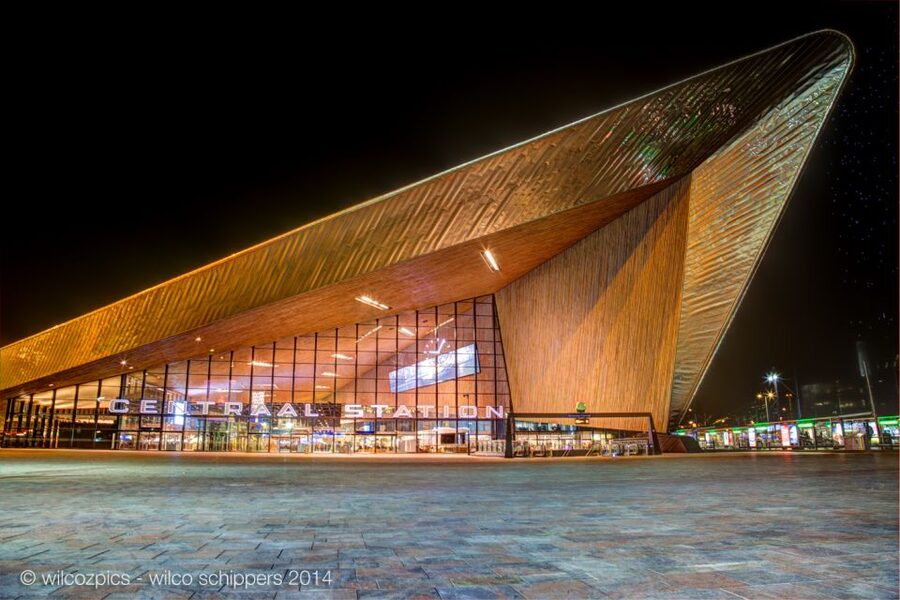
You meet at Rotterdam Central Station, then head through the city with a local guide who keeps the story moving. You’ll pass major landmarks like the Town Hall and St. Lawrence Church, and you’ll learn why Rotterdam became so willing to build bold after devastation.
The big win is that this tour earns consistently high marks, holding a 4.6 out of 5 rating from 58 bookings. People highlight that the guide answers questions and makes the buildings feel personal, which is exactly what you want on a quick city orientation.
In This Review
- Key things to know before you go
- Why This Rotterdam Walk Works: Modern Rebuild Meets Real City Life
- Starting at Rotterdam Central Station, Then Finding the Main Story
- World War II Bombing, Then Modern Design Everywhere
- Timmerhuis and OMA, Rotterdam’s Big-Name Architecture Moment
- Markthal: Where Local Life Happens Under One Roof
- Cube Houses and Erasmus Bridge for Photos With Meaning
- Shopping Streets and the Best Trick: Ask Questions as You Walk
- Price, What You Get for $25, and Who This Tour Fits
- Should You Book This 2-Hour Guided Walking Tour of Rotterdam?
- FAQ
- Where is the meeting point?
- How long is the Rotterdam walking tour?
- What is the price per person?
- What is included in the tour?
- Are food and drinks included?
- What languages are available?
- Is there a private group option?
- Is free cancellation and reserve-pay-later available?
Key things to know before you go
- Central Station start keeps your bearings simple, even on your first day in town
- You’ll connect WWII history to why modern architecture is everywhere
- Markthal is more than a photo stop, it’s built for everyday local life
- Cube Houses are explained as an urban design idea, not a random oddity
- You cover major modern icons like Timmerhuis (OMA) and Erasmus Bridge in one walk
- The tour runs with a live English, Dutch, or German guide, and you can ask questions along the way
Still in Rotterdam? Keep going
- Rotterdam: Harbor Sightseeing Cruise★ 4.3 · 7,599 reviews
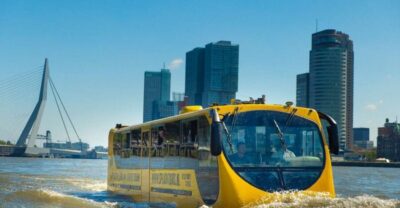
- Rotterdam: 1-Hour Sightseeing Splash Tour★ 4.5 · 3,299 reviews
- Rotterdam: Rotterdam Zoo Blijdorp Entry Ticket★ 4.6 · 2,754 reviews
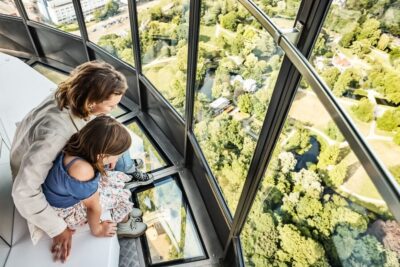
- Rotterdam: Euromast Lookout Tower Ticket★ 4.4 · 2,549 reviews
Why This Rotterdam Walk Works: Modern Rebuild Meets Real City Life
Rotterdam has a personality that comes through fast. It’s not the kind of city that waits for you to slow down and appreciate it from a distance. It’s practical and confident, with architecture shaped by real events, real damage, and real ambition.
That’s why I like this tour format. In a short 2-hour loop, you get the big story: Rotterdam rebuilt hard after World War II, and the city’s later wealth of modern design grew out of that need and that momentum. Your guide also adds the human layer, pointing out where people shop, work, and simply live day to day.
A guided walk like this is also good value when time is tight. At $25 per person, you are paying for local interpretation. Without a guide, you might recognize famous buildings, but you’d miss the “why” that makes them make sense.
Starting at Rotterdam Central Station, Then Finding the Main Story
You begin at Rotterdam’s Central Station, which is a smart move. It’s a clear meetup point and it helps you start the city in the right place, not half-lost on side streets before the tour even begins.
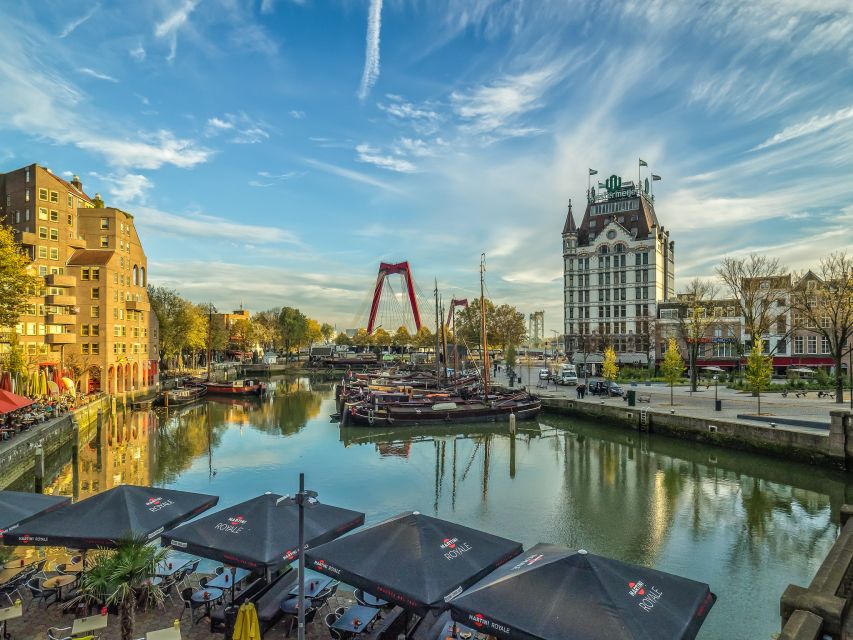
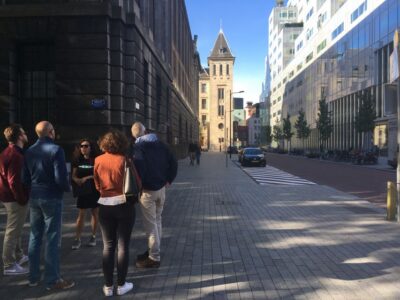
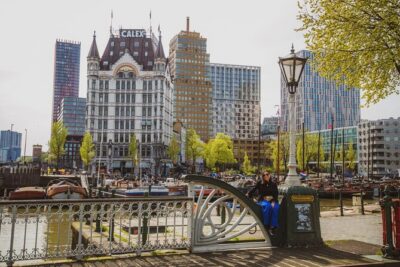
From there, the route focuses on landmarks and ideas that explain Rotterdam’s development. You’ll pass by the Town Hall and St. Lawrence Church, then you’ll learn about Europe’s first high-rise building. That matters because it shows Rotterdam’s early willingness to experiment with scale and height, long before today’s skyline talk.
The key is how the guide connects those stops. You’re not just ticking sites off a list. You’re building a quick mental map: this is where civic power looks like, this is where faith and community show up, and this is where Rotterdam hints at its future way of building.
Tip for your comfort: wear shoes that can handle city walking. Rotterdam paths and routes are straightforward, but this tour is designed to cover a lot in a short time, so you’ll feel the pace if you’re in dressier footwear.
World War II Bombing, Then Modern Design Everywhere
One of the most useful parts of the tour is the way your guide explains what happened during the World War II bombing and why modern architecture is so abundant in Rotterdam today.
This is not just trivia. Understanding the war context changes how you read the city. When you look at glassy contemporary buildings later, you’ll understand they are not just style choices. They’re part of a rebuilding mindset, a practical response, and a long-running decision to reshape the urban landscape.
If you’ve ever visited a city where the old survived quietly, Rotterdam feels different. The architecture reads like it has momentum. Even if you’re not an architecture buff, the story gives you a lens to interpret what you see along the way, from the civic core to newer office and public spaces.
This is also why you’ll likely enjoy this tour even if you only remember a few building names. You’ll leave with a clear explanation for the pattern: history drives form, and form tells history.
Timmerhuis and OMA, Rotterdam’s Big-Name Architecture Moment
After the older landmarks and the rebuilding story, the tour shifts into modern structure mode. One stop that anchors that transition is The Timmerhuis, designed by the world-famous architects of OMA.
What you should look for here is how the building signals Rotterdam’s current identity. It’s not trying to blend in. It’s trying to read as modern work, modern city planning, and modern ambition. Even if you don’t know architectural theory, your guide can translate the design cues into plain language.
This section also gives you a good reality check. Rotterdam isn’t only about experimental oddities like the Cube Houses. It also builds serious mainstream urban architecture that supports business and city functions. That makes the walk feel balanced, not like a theme park of only the weird or only the pretty.
If you like asking questions, this is a great stretch to do it. It’s easier to understand design intent when someone has just pointed out the specific architect connection, rather than talking generally about Rotterdam’s style.
Prefer to see it on foot? More Rotterdam walks
Markthal: Where Local Life Happens Under One Roof
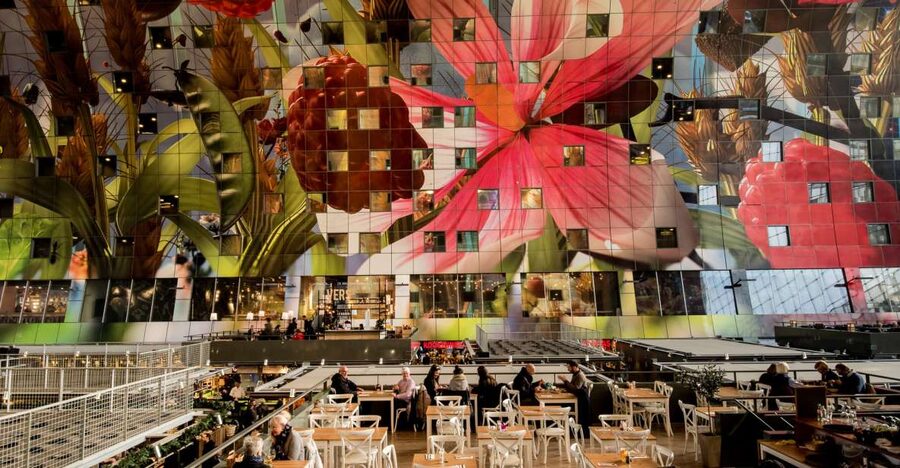
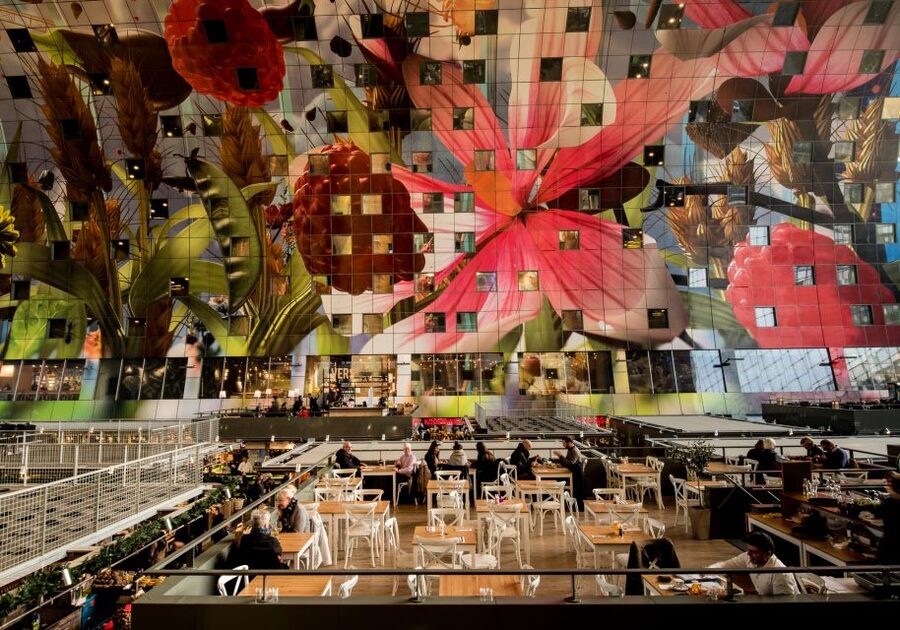
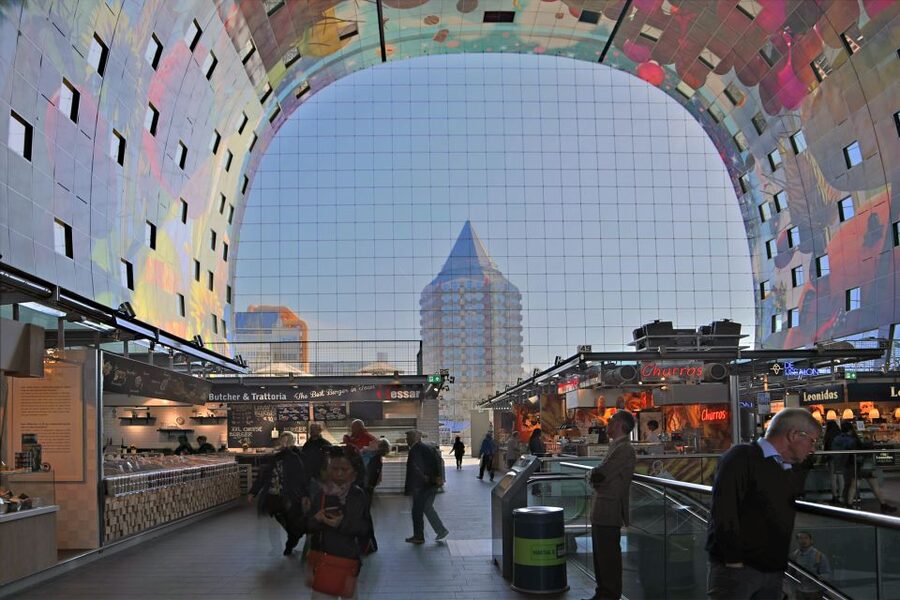
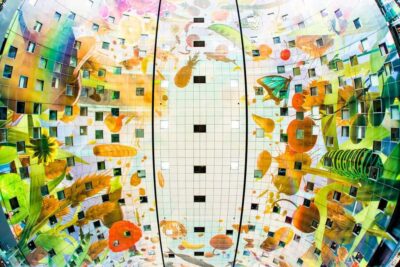
The Markthal is one of the most practical and interesting stops on the route. The guide brings you to the Markthal, described as Europe’s most unique and beautiful covered market. The important part is the word covered.
You’re not just looking at a landmark facade. You’re stepping into a space built for everyday movement: browsing, buying, and people-watching in weather-proof comfort. Even though food and drinks are not included, you can still sense how designed it is for daily habits, not special occasions.
What I love about Markthal in a guided setting is timing. In a short tour, you get enough time to register the atmosphere without turning the visit into a long detour. And because the guide is talking about Rotterdam’s city life, you will understand what markets like this are doing for the neighborhood.
If you want one simple souvenir from this stop, it’s an updated mental image of Rotterdam as a city that mixes modern architecture with functional public space. Markthal is proof that new design can still serve ordinary routines.
Cube Houses and Erasmus Bridge for Photos With Meaning
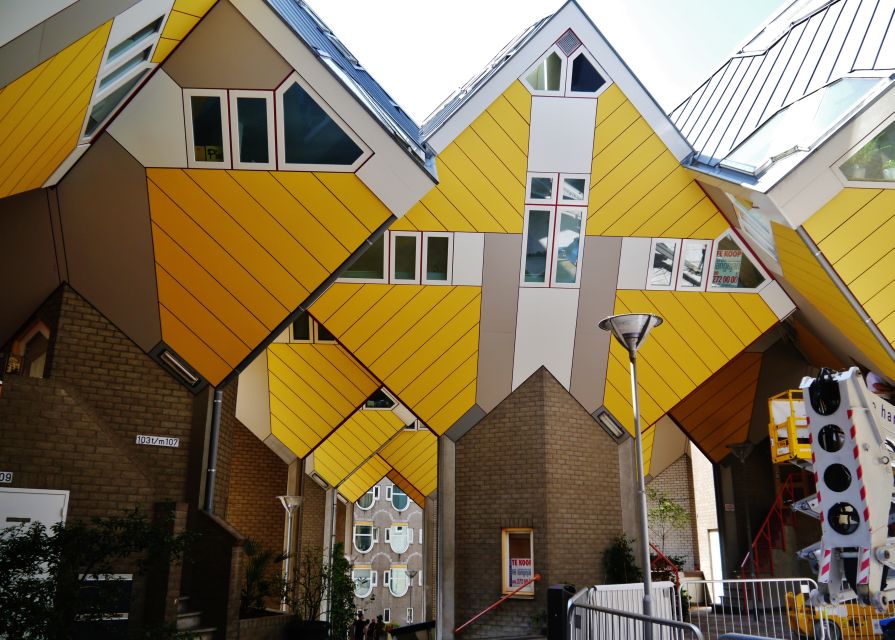
Next comes the visual signature that many people think of first when they hear Rotterdam: the Cube Houses. These are the kind of buildings you can’t really understand from a distance, which is why this tour is so helpful. Your guide frames them as an inventive design idea, not just a quirky landmark.
From there you’ll move toward the Erasmus Bridge, another must-see modern icon. Bridges can be just background in a city, but when your guide ties it to the surrounding design choices, it becomes part of the Rotterdam story. It’s about movement, the city’s relationship to infrastructure, and how modern design helps connect spaces.
For your own viewing, here’s the practical approach: don’t just take one photo. Take a step back, watch how the structure looks from a distance, then move closer and check how it changes from angle to angle. Rotterdam’s buildings often look different as you shift your position, and this tour route gives you those natural viewing moments.
Shopping Streets and the Best Trick: Ask Questions as You Walk
A big part of the value here is that the tour doesn’t feel like a lecture glued to a walking schedule. As you continue through shopping streets and modern city areas, your guide keeps the explanations tied to what you are actually seeing.
This is where you can steer the experience a bit. If you care most about architecture, ask about how the post-war rebuilding shaped what came next. If you care about culture, ask about how Rotterdam’s public spaces support everyday life, especially around places like the Markthal. If you’re curious about the city’s harbor context, prompt your guide for the short version.
Also, if you want to meet the guide with a few questions ready, do it at the start while you’re still near Central Station. You’ll waste less time mid-walk trying to remember what you wanted to ask.
Private group options can help here too, if you want a quieter, more custom pace. The tour works as a group walk, but a private setup can be better if you want lots of back-and-forth.
Price, What You Get for $25, and Who This Tour Fits
At $25 per person for 2 hours, this is the kind of tour I think is worth it when you want quick context. You’re paying for a live guide, and that matters in a city like Rotterdam where architecture connects to events and planning decisions.
What’s included is simple: a local guide. What is not included: food and drinks. That’s normal for a walking tour, but it’s good to know so you can plan your meal stop afterward.
Because the tour is short, it suits certain travel styles:
- First-timers who want a fast orientation with major icons
- People who like architecture but do not want a full day of planning
- Visitors who prefer explanations tied to real places, not just guidebook reading
- Anyone who wants to leave with a clearer story of Rotterdam’s rebuilding and modern design choices
It may be less ideal if you want long time inside markets, churches, or museums, or if you’re hoping for a slow meander with lots of pauses. This is built to cover key highlights and give you a strong overview.
Should You Book This 2-Hour Guided Walking Tour of Rotterdam?
If you’re visiting Rotterdam for the first time, short on time, and you want a guided explanation of the city’s architecture and how the WWII story shaped it, then yes, I think you should book. This tour gives you the essentials in a practical loop: Central Station to civic landmarks, modern icons like Timmerhuis and Erasmus Bridge, and the two biggest “feel Rotterdam” stops, the Markthal and the Cube Houses.
If you want food included, this is not the one. But if you want to understand what you are looking at, and then go explore more on your own afterward, this is a solid way to start.
FAQ
Where is the meeting point?
The meeting point may vary depending on the option booked, but the tour is described as meeting at Rotterdam’s Central Station.
How long is the Rotterdam walking tour?
The duration is 2 hours.
What is the price per person?
The price is $25 per person.
What is included in the tour?
A local guide is included.
Are food and drinks included?
No, food and drinks are not included.
What languages are available?
The live tour guide is available in English, Dutch, and German.
Is there a private group option?
Yes, a private group is available.
Is free cancellation and reserve-pay-later available?
You can cancel up to 24 hours in advance for a full refund, and you can reserve now and pay later.
Everything Else From Our Rotterdam Notebook



Also Reviewed Around Rotterdam



Still in Rotterdam? Keep Going
Fresh off the review pile in Rotterdam
- Private tour: Markthal, Cube houses and Rooftop Het Witte Huis
★ 4.5 · 3 reviews - Private transfer Schiphol (AMS) to or from Rotterdam
★ 5.0 · 3 reviews - Private tour from Rotterdam to Windmills of Kinderdijk & Gouda Cheese Experience
★ 5.0 · 3 reviews - Private Transfer from Rotterdam Port to Amsterdam Airport (AMS)
★ 5.0 · 3 reviews - Discover Rotterdam’s most Photogenic Spots with a Local
★ 5.0 · 3 reviews
Rotterdam Tours, compared.
 ★ 4.3Rotterdam: Harbor Sightseeing CruiseFrom $227,599 reviews
 ★ 4.5Rotterdam: 1-Hour Sightseeing Splash TourFrom $353,299 reviews
 ★ 4.6Rotterdam: Rotterdam Zoo Blijdorp Entry TicketFrom $322,754 reviews
 ★ 4.4Rotterdam: Euromast Lookout Tower TicketFrom $212,549 reviews
 ★ 4.4Rotterdam: Pancake CruiseFrom $311,986 reviews
 ★ 4.2From Amsterdam: Rotterdam, Delft & The Hague Guided Day TourFrom $901,765 reviews
 ★ 4.6Rotterdam: Kinderdijk UNESCO World Heritage Entry TicketFrom $251,477 reviews
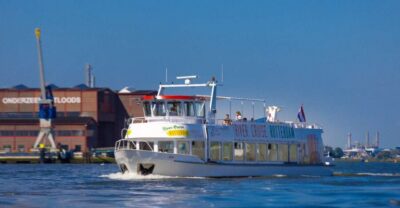 ★ 4.0Rotterdam: Harbor Cruise with Live GuideFrom $141,270 reviews
Browse the lists this tour appears in