
REVIEW · ROTTERDAM
Rotterdam Must Do Tour: Highlights, History, WW2 and Architecture
Rotterdam tells its story on your feet. In this 2-hour small-group walk, I love the WWII-to-today architecture focus and the chance to see key spots like Markthal up close, not just from the sidewalk. The main drawback is the time limit, so you may have to move along fairly quickly at a few stops.
You’ll start at Stationsplein 10, right by Rotterdam Centraal, and the route is built to make the city feel connected, from the harbor area to the wooden path of Luchtsingel. The group cap of 15 travelers helps keep the pace human, and guides like Edwin and Michel are specifically praised for turning hard history into clear, conversational street-level stories.
For about $29.41 per person, you get a local guide plus free admission at the listed stops. Just plan your own snacks, because food and drinks aren’t included.
In This Review
- Key things you should know before you go
- Rotterdam walking tour: a fast, smart way to understand the city
- Meeting at Stationsplein 10, then getting oriented quickly
- Rotterdam Centraal Station: why the guide’s architecture talk matters
- Groot Handelsgebouw: 1953, after the bombing, and a turning point
- Shopping streets, rebuilt districts, and the Lijnbaan story
- Luchtsingel wooden bridge: walking the city’s reconnection plan
- Nieuwe Delftse Poort and Cor Kraat’s steel reconstruction
- Sint-Laurenskerk: the one medieval survivor you should see inside
- Markthal: MVRDV’s horseshoe design plus the giant food-and-nature artwork
- Oude Haven and the Cube Houses near the Maas
- Price and value: what $29.41 buys you in Rotterdam
- Who this tour suits best, and who might want something else
- Pace, comfort, and practical tips for a smooth walk
- So, should you book this Rotterdam Must Do Tour?
- FAQ
- How long is the Rotterdam walking tour?
- How much does it cost?
- What languages is the tour offered in?
- How large is the group?
- Where do we meet and where does the tour end?
- Are food and drinks included?
- Is admission free for the stops?
- Can I cancel and get a full refund?
Key things you should know before you go
- WWII rebuild through real buildings, including a post-bombing landmark completed in 1953
- Markthal’s inside-out design, plus the famous oversized food-and-nature artwork inside
- A walk that links neighborhoods, with Luchtsingel connecting Rotterdam North and the center on foot
- A small group size (max 15) that supports questions and quick follow-ups
- Guides that earn praise by name, including Susan, Tony, and Stephan for clarity and flexibility
More wartime ground to cover in Rotterdam
- Rotterdam Walk: Hilights, Gems, Architecture & WWII | 2 or 3hrs★ 5.0 · 149 reviews
- Rotterdam Must Do Tour: Highlights, History, WW2 and Architecture★ 5.0 · 20 reviews
Rotterdam walking tour: a fast, smart way to understand the city
If your first instinct is to treat Rotterdam like a modern design city, this tour nudges you toward the backstory that explains the look. The whole walk is really about how Rotterdam rebuilt itself, then kept reinventing itself, block by block, bridge by bridge. You end up with a mental map of the city and a reason for why the architecture looks the way it does.
I like that it’s not a “check off famous buildings” stroll. It’s a guided explanation of how Rotterdam’s harbor setting, war damage, and later planning decisions shaped what you see today. And because the group is kept small, you’re more likely to get direct answers instead of just hearing one-way narration.
Meeting at Stationsplein 10, then getting oriented quickly
You meet at Stationsplein 10 (3013 AJ Rotterdam). From there, it’s easy to arrive because it’s near public transportation, and it’s a straightforward starting point if you’re coming from Rotterdam Centraal.
This matters more than it sounds. Rotterdam can feel big and spread out, especially if you’re used to older cities with compact centers. Starting near the station helps you get your bearings fast, before the tour starts weaving in bridges, gates, and market halls.
Also, it’s listed as a mobile-ticket experience, so you can keep things simple on your phone. Service animals are allowed, and the tour notes that most travelers can participate, which usually means the walking is manageable for a typical visitor.
Rotterdam Centraal Station: why the guide’s architecture talk matters
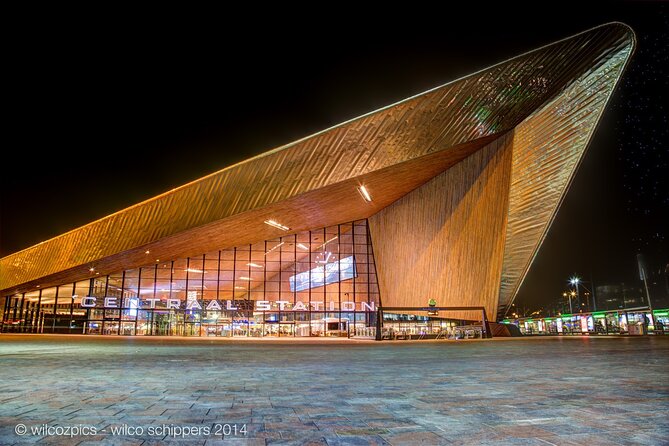
One of the early stops is Rotterdam Centraal Station. You spend about half an hour there, and the guide focuses on architecture, not just “this is the station.”
This is a great moment for first-timers. The station area gives you a structural viewpoint: Rotterdam is a city that rebuilds for function and future use. If you pay attention here, you’ll understand why later stops feel purposeful, like part of one long urban plan instead of random attractions.
In the feedback I’d listen for, guides such as Michel and Edwin are highlighted for making the city’s design logic click. If you get a guide with that style, you’ll leave the station feeling like you can “read” the city.
Groot Handelsgebouw: 1953, after the bombing, and a turning point
Then you head toward Groot Handelsgebouw, a major building completed in 1953. The point here isn’t just the date. It’s what the date represents, one of the first major post-Second World War constructions in Rotterdam.
Rotterdam was heavily damaged during WWII, and later decisions shaped everything from street layouts to the kinds of buildings that replaced older structures. This stop helps you connect the emotional history to a concrete skyline fact. You see that the city’s modernization wasn’t theoretical. It was urgent, practical, and built fast enough to still influence today’s identity.
The practical side: this is a shorter stop (about 10 minutes), so bring your curiosity, not your expectation of a long monument visit. I treat these quick exterior stops as “chapter markers,” so I don’t feel robbed when we move on.
Still in Rotterdam? Keep going
Shopping streets, rebuilt districts, and the Lijnbaan story
From here, you move through the shopping district area, including West-Kruiskade and Lijnbaan. These are well-known streets in the center, and the guide’s job is to explain why they look the way they do and how their creation ties back to destruction and rebuilding.
Lijnbaan is especially worth listening to. It opened in 1953 as a main pedestrian street in the new shopping district after the old shopping area was completely destroyed during the bombing. That’s a big deal, because pedestrian planning at that scale signals how Rotterdam intended to remake everyday life, not just replace buildings.
Here’s the best way to use this section: think of it like an outdoor timeline. Even if you don’t buy anything, notice how a pedestrian street supports crowds and commerce, then notice how Rotterdam’s later architecture choices fit the wider urban feel.
If you’re the kind of traveler who dislikes shopping streets, you’ll still get value because the tour frames them as reconstruction artifacts. If you love street-level design, you might even spot details that you’d otherwise ignore.
Luchtsingel wooden bridge: walking the city’s reconnection plan
One of the most memorable parts of the route is Luchtsingel. This is a wooden pedestrian bridge that stretches 390 meters, connecting Rotterdam North with Rotterdam Center.
The guide’s framing matters here: this bridge is described as bringing new life to a part of the city that had been abandoned for years, marked by vacancy and neglect. So instead of treating it like a scenic shortcut, you treat it like an urban stitch, a way of linking places back together.
For me, this is the moment where the tour feels most “Rotterdam.” The city is famous for bold architecture, but Luchtsingel is human-scale infrastructure. It also gives you a different perspective than the dense center streets.
Tip: since the route includes multiple short segments, keep your phone ready for photos but don’t let photography slow your pace. The bridge is best when you actually walk it, not when you stop every 20 seconds.
Nieuwe Delftse Poort and Cor Kraat’s steel reconstruction
Next comes Nieuwe Delftse Poort, a reconstruction on the site of a city gate. The original Delft gate is described as the last built in 1764. Then, about fifty years later, a reconstruction in steel designed by the artist Cor Kraat was erected near the original location on Pompenburg.
This stop is a lesson in how cities use the past without freezing it. Rotterdam isn’t trying to pretend it never changed. Instead, it reintroduces older elements in new materials, so the “gate idea” lives on while the city’s real timeline stays visible.
The stop is short (about 10 minutes), so you likely won’t have time for a deep history lesson on site. But if your guide shares the context well, you’ll understand why it feels like a bridge between eras: medieval intent, modern material.
Sint-Laurenskerk: the one medieval survivor you should see inside
You’ll also visit Grote of Sint-Laurenskerk, a Protestant church and the only remnant of medieval Rotterdam. The tour notes that you can also go inside for free.
This is one of the stops I’d prioritize in your head, because it contrasts with the city’s WWII rebuild narrative. Rotterdam’s modern identity is built from destruction and recovery, but this church is a surviving fragment that reminds you the city existed long before the post-war rebuilding wave.
Practical advice: wear shoes you can stand in. A church visit can be brief on a tour, but if you step inside at all, you’ll want to take a breath and look around slowly for a minute.
Markthal: MVRDV’s horseshoe design plus the giant food-and-nature artwork
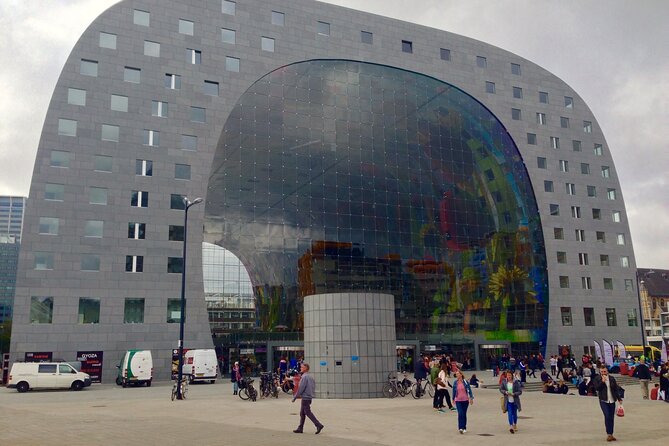
Markthal is where a lot of people’s interest peaks, and the tour gives you about 30 minutes there. Designed by MVRDV, the building is described as a grey nature-stone structure with an archwise, horseshoe-like form.
What makes it special is the inside experience. The tour points out that Markthal holds many restaurants and features an impressive artwork showing strongly enlarged fruits, vegetables, seeds, fish, flowers, and insects. It’s the kind of art that makes you look twice because it’s both playful and carefully constructed.
The best way to enjoy Markthal on a tour is to do two passes. First, look at the architecture from outside or at the entry points, then once inside, pause to find the artwork elements and read them like a collage. If your guide points out details, follow their cue. If not, you can still get the experience by simply allowing yourself a short, focused look.
One caution: because this is a guided walk with a set route, your 30 minutes can feel like “enough to see it, not enough to linger.” If you love design markets, consider visiting again later on your own time for longer browsing.
Oude Haven and the Cube Houses near the Maas
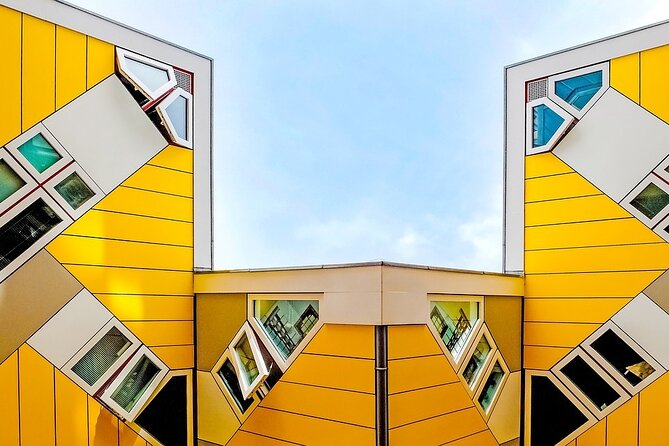
The final highlight area is Oude Haven, the old harbor hotspot in Rotterdam’s city center, on the north side of the Maas River. This area is described as developing into a vibrant, active place, and it’s also where you’ll find the famous Cube Houses.
Even without extra time, Oude Haven works as a payoff stop. It ties the tour’s themes together: the harbor identity, the mix of old and new, and the way Rotterdam turned damage and redevelopment into a city style people now recognize instantly.
If you’re a photo person, this is usually where you stop taking “tour photos” and start taking photos you’d actually print. The Cube Houses and the water-adjacent setting give you strong angles and a clear sense of place.
The tour ends back at the meeting point, keeping the whole day simple for your schedule.
Price and value: what $29.41 buys you in Rotterdam
At $29.41 per person for about two hours, you’re paying for a local guide and the ability to hit multiple key Rotterdam landmarks without researching every stop. The tour also lists admission as free for the listed sights, which helps keep your budget predictable.
In practice, this price is best viewed as time-savings plus interpretation. Rotterdam’s architecture can be visually striking but sometimes hard to “decode” without context. The guide’s WW2-to-rebuild story gives you a framework, so what you see doesn’t feel like random modern shapes.
What you don’t get is food and drinks. That’s normal for a walking highlights tour. I plan a snack break before or after, depending on where you want to end up for lunch.
Who this tour suits best, and who might want something else
This tour is a strong match if you:
- want a short, organized way to understand Rotterdam’s rebuilding and architecture
- enjoy architecture and city planning explanations, especially those tied to WWII
- like small-group walking tours where you can ask questions
- are visiting with limited time and want a dense hit list that still feels guided
You might want a different option if you:
- need lots of time inside places and don’t like moving between many points
- prefer museum-style depth over street-level architecture context
- want a food-focused market experience, because the tour time in Markthal is set for walking flow, not long lingering
Pace, comfort, and practical tips for a smooth walk
Because the route covers many stops with short time allocations, expect a pace that’s active. It’s not a “wander and graze” day. That’s not a bad thing. It’s how you fit Rotterdam’s big themes into about two hours.
A couple practical moves help:
- wear comfortable shoes for repeated short walks between sites
- bring water if you’re sensitive to heat or walking time, since no drinks are included
- save your deepest Markthal exploration for later if you want more than a quick architectural sweep
If you’re traveling with kids or someone who tires easily, the small group size can help, but the tight schedule still matters. I’d go into it ready to enjoy the highlights, then plan a slower follow-up day for your favorite stop.
So, should you book this Rotterdam Must Do Tour?
I’d book it if you want the Rotterdam you can actually explain to someone later. The value comes from how the guide connects WWII recovery to the architecture you see in real places: a 1953 post-war landmark, pedestrian shopping planning after destruction, a wooden bridge built to reconnect neighborhoods, and Markthal’s design signature.
You’ll especially like this tour if your travel style is part sightseeing, part “why did the city do this?” thinking. Just be honest about time: it’s a highlights route, so you may want to circle back to Markthal or the Oude Haven area later if you fall in love with something you saw.
If you want a compact, high-impact introduction to Rotterdam’s rebuilt identity, this is an easy yes.
FAQ
How long is the Rotterdam walking tour?
The tour runs for approximately 2 hours.
How much does it cost?
The price is listed as $29.41 per person.
What languages is the tour offered in?
It is offered in English.
How large is the group?
The tour has a maximum of 15 travelers.
Where do we meet and where does the tour end?
You meet at Stationsplein 10, 3013 AJ Rotterdam, Netherlands, and the tour ends back at the meeting point.
Are food and drinks included?
No. Food and drinks are not included.
Is admission free for the stops?
The tour listing shows free admission tickets for the listed stops, and it also notes you can go inside Sint-Laurenskerk for free.
Can I cancel and get a full refund?
Yes. You can cancel for free up to 24 hours in advance for a full refund.
Also Reviewed Around Rotterdam




Still in Rotterdam? Keep Going
Wartime Rotterdam
Fresh off the review pile in Rotterdam
- Private tour: Markthal, Cube houses and Rooftop Het Witte Huis
★ 4.5 · 3 reviews - Private transfer Schiphol (AMS) to or from Rotterdam
★ 5.0 · 3 reviews - Private tour from Rotterdam to Windmills of Kinderdijk & Gouda Cheese Experience
★ 5.0 · 3 reviews - Private Transfer from Rotterdam Port to Amsterdam Airport (AMS)
★ 5.0 · 3 reviews - Discover Rotterdam’s most Photogenic Spots with a Local
★ 5.0 · 3 reviews
Rotterdam Tours, compared.
 ★ 4.3Rotterdam: Harbor Sightseeing CruiseFrom $227,599 reviews
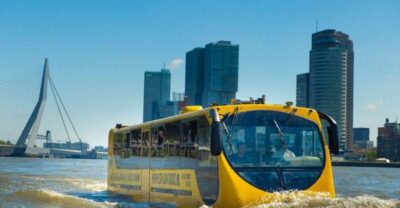 ★ 4.5Rotterdam: 1-Hour Sightseeing Splash TourFrom $353,299 reviews
 ★ 4.6Rotterdam: Rotterdam Zoo Blijdorp Entry TicketFrom $322,754 reviews
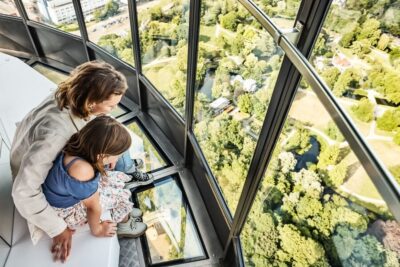 ★ 4.4Rotterdam: Euromast Lookout Tower TicketFrom $212,549 reviews
 ★ 4.4Rotterdam: Pancake CruiseFrom $311,986 reviews
 ★ 4.2From Amsterdam: Rotterdam, Delft & The Hague Guided Day TourFrom $901,765 reviews
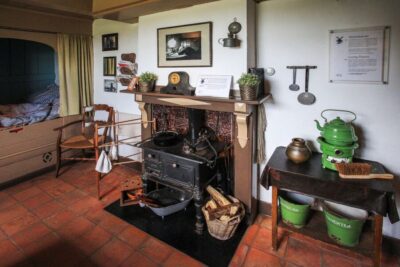 ★ 4.6Rotterdam: Kinderdijk UNESCO World Heritage Entry TicketFrom $251,477 reviews
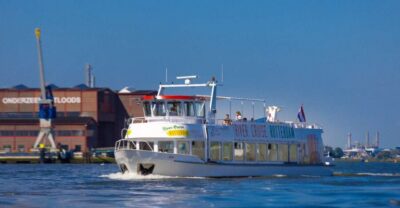 ★ 4.0Rotterdam: Harbor Cruise with Live GuideFrom $141,270 reviews
Browse the lists this tour appears in