
REVIEW · AMSTERDAM
Amsterdam: “Operation 45 ” Treasure Hunt Walking Tour
Diamonds, puzzles, and Amsterdam streets. I like the WWII story and the way you solve clues by studying architecture details along the route. One caution: this is game time, so if you want mostly sightseeing with zero mental work, you may feel the pace is a bit busy.
What I enjoy most is that this is not just a walk with facts. You work the trail like an escape room, but outside, in real neighborhoods that most people skip. The route also takes you toward places like the Shadow Wall, the Portuguese Synagogue area, Artis Zoo, and a diamond factory story stop.
For me, the biggest trade-off is time. The hunt is scheduled for about 2 hours on a 3 km route, but it can stretch to 2 to 3 hours depending on how fast your group solves puzzles and keeps moving.
In This Review
- Key things to know before you play
- Solving Amsterdam like an escape room, but on foot
- Your HQ at Mystery City Games, and the backpack setup
- Operation 45: the WWII diamond-heist story you follow
- The old Jewish District walking route, stop by stop
- Shadow Wall: where the architecture becomes the clue
- Portuguese Synagogue: history with a puzzle purpose
- Artis Zoo: a surprising stop on a wartime mission
- The diamond factory stop: the mission’s satisfying push forward
- How long it really takes, and how to pace yourself
- Who this Amsterdam treasure hunt suits best
- Price and value: is $29 worth it?
- What to bring and what to expect day-of
- Should you book Operation 45 in Amsterdam?
- FAQ
- Where is the meeting point for Operation 45?
- How long is the walking tour?
- What locations do we visit during the hunt?
- Do I need an app for the game?
- What should I bring?
- Is it suitable for kids?
- Is it wheelchair accessible?
Key things to know before you play
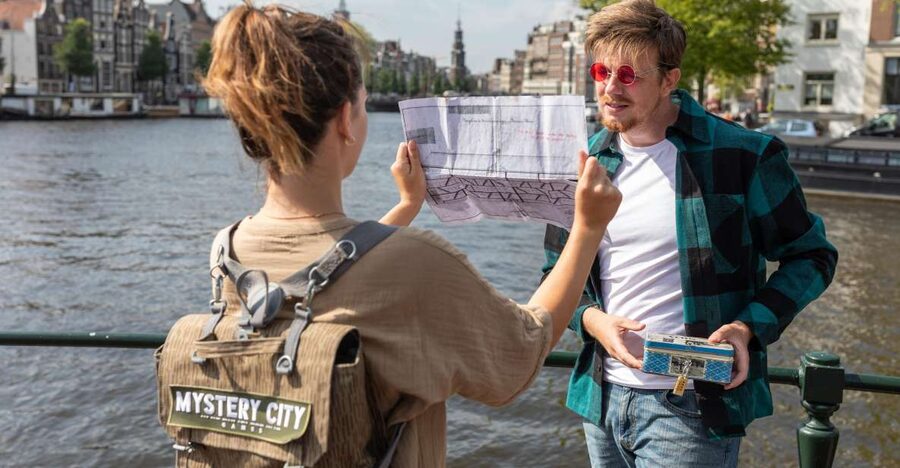
- Real puzzle gear, not an app: you get a backpack with maps, boxes, and locks to handle on your own.
- Architecture-based clues: you solve using hints hidden in the city’s details, not just reading a script.
- Old Jewish District focus: you spend time away from the most crowded center while still hitting famous landmarks.
- WWII diamond-heist storyline: the mission is built around a true missing-diamonds tale in Amsterdam.
- Short and active: it is about 3 km and typically lands near 2 hours, but plan breathing room.
More puzzle walks you can start whenever you feel like it
- Amsterdam Treasure Hunt: The Mystery of a Secret Sender★ 5.0 · 149 reviews
- Amsterdam: Treasure Hunt Walking Tour “A Secret Sender”★ 4.7 · 71 reviews
- Amsterdam Red Light District Treasure: Self-Guided Tour & Quest★ 5.0 · 39 reviews
- Discover Amsterdam’s city center in this Outside Escape game tour★ 4.5 · 18 reviews
Solving Amsterdam like an escape room, but on foot
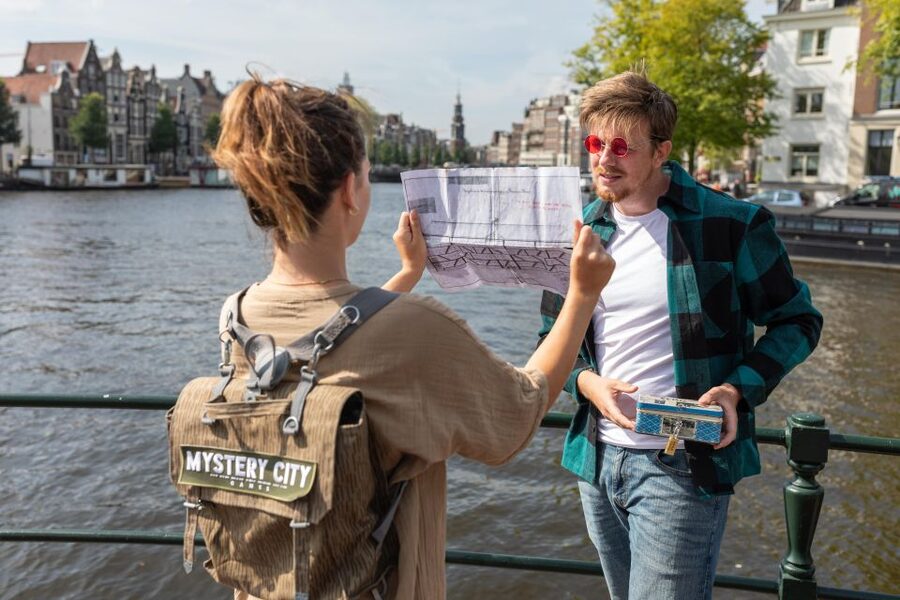
This is a treasure hunt that borrows the best parts of escape rooms: hands-on items, puzzle steps, and a clear goal that keeps you focused. Instead of waiting for a guide to talk the whole time, you and your group get a mission and then you earn the next clue at each stop.
The biggest value for you is how interactive it feels. You are not just looking at buildings, you are hunting for specific details in the architecture and using physical tools to move forward. That changes how you see Amsterdam, because you start noticing things you would otherwise miss.
The game style also means there is a built-in rhythm. You will pause, solve, walk to the next location, and repeat. If you enjoy puzzles and enjoy thinking while you walk, this is great energy. If you do puzzles slowly, the total time can creep upward.
Your HQ at Mystery City Games, and the backpack setup
You start at Mystery City Games at Zwanenburgwal 178 (look for the Mystery City Games sign), which acts as the mystery HQ. Early on, you meet the Game Master, who brings you into the storyline and sets up how the hunt works.
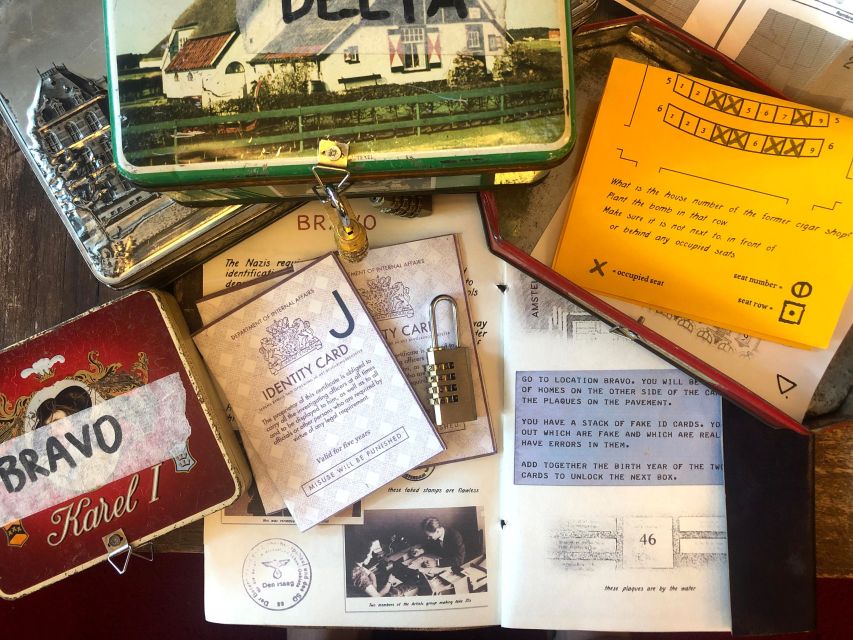
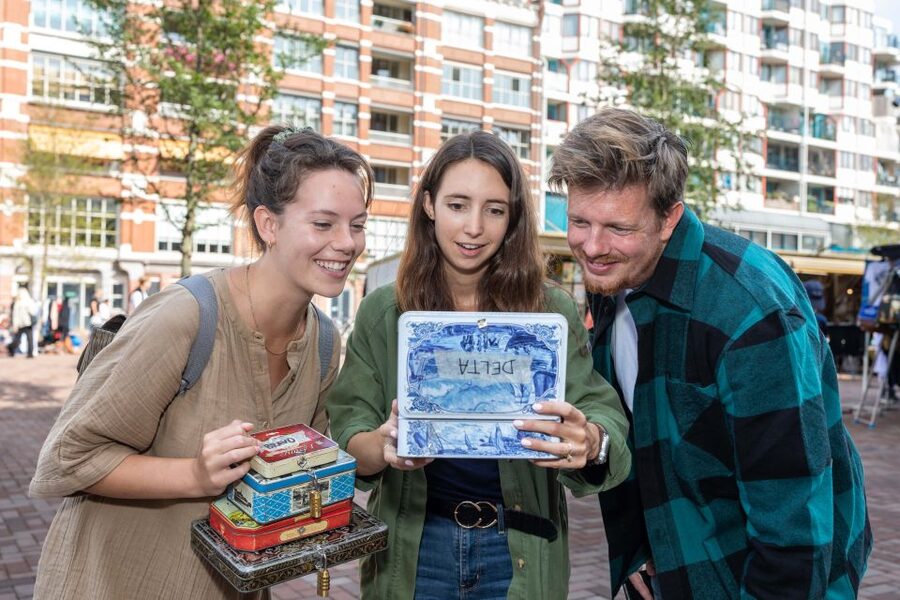
Then comes the part that makes the experience feel real: you receive a backpack with old tins and maps plus puzzle components like boxes and locks. This is not a phone app. You handle the gear, open the right box, use the tools you have, and follow the trail step by step.
I like this approach because it is easy to follow without needing big instructions on a screen. It also makes the group dynamic more hands-on, even if you are traveling with people who normally do not care about puzzle games.
Operation 45: the WWII diamond-heist story you follow
The premise is instantly engaging. At the beginning of WWII, a cache of diamonds went missing in Amsterdam, and you are stepping into that investigation with the Dutch Resistance trail.
At each location, you get one piece closer by solving puzzles tied to the architecture and using items from your backpack. Along the way, you also learn stories of the Dutch Resistance in WWII, which gives the game more meaning than just clever riddles.
This is where the hunt becomes more than entertainment. The route is designed around historic context, including the former Jewish District and its sites. If you like history that you can feel in the street layout and the built environment, you will probably enjoy how the story guides your attention.
The old Jewish District walking route, stop by stop
The hunt covers a 3 km route and is timed at about 2 hours. The stops are spread across five different locations in Amsterdam’s old Jewish District, each one tied to puzzle steps and WWII storytelling. Along the way, you may see how the neighborhood’s past still shows in details and layout.
The route also includes well-known landmarks you can recognize, such as the Shadow Wall and the Portuguese Synagogue. But it also pushes you toward lesser-visited, story-driven corners where the game encourages slower looking.
One practical consideration for you: since the puzzles require attention, you might walk more slowly than you would on a standard sightseeing stroll. If you have a tight schedule afterward, build in a buffer.
Prefer to see it on foot? More Amsterdam walks
Shadow Wall: where the architecture becomes the clue
Shadow Wall is one of the key story locations, and it works well for this game format because it encourages close observation. Instead of just passing it, you are meant to notice specific details and then connect those details to the puzzle you need to solve.
What makes this stop valuable is the change in focus. You do not treat the building like a backdrop. You treat it like evidence in a case. That is the magic trick of this type of tour: the city stops being scenery and becomes part of the game.
Potential drawback: if your group wants big views and photos every 30 seconds, the puzzle mode may feel more like reading and searching than sightseeing.
Portuguese Synagogue: history with a puzzle purpose
The Portuguese Synagogue is another featured stop, and it adds gravitas to the storyline. Because this is a puzzle hunt, you are not only seeing a landmark. You are also learning through the game prompts and the step-by-step clues that come with it.
This stop is a good example of how the tour balances story and interaction. The WWII theme connects you to the neighborhood’s historical layers, while the puzzle requires you to stay mentally present instead of letting the time fly by.
What you should expect here: a slower pace while you work out the next clue. If you like the idea of learning by doing, this type of stop is usually a win.
Artis Zoo: a surprising stop on a wartime mission
Artis Zoo appears on the route as another puzzle location. The interesting part is the contrast. Your mission is WWII, but your walk includes a site people often associate with leisure and animals.
That contrast can be helpful. It prevents the tour from feeling like a single-theme march from one solemn place to another. You get a mental reset, and the game keeps you moving forward.
You may not get a full zoo visit experience, since the tour focuses on the hunt. But you will likely use the stop as part of solving clues and advancing the story.
The diamond factory stop: the mission’s satisfying push forward
Near the end, you reach a diamond factory stop, tied to the climactic theme of the missing diamonds case. This is the point where the whole experience starts to feel like a true investigation with momentum.
It also helps that the hunt is structured as a trail of five locations. You are not dropping into random stops. Each one nudges you closer to the final answer, and the diamond-focused storyline makes the ending feel more coherent.
If you enjoy endings that reward your effort, this last stretch is usually where the group energy picks up.
How long it really takes, and how to pace yourself
The tour is designed for about 2 hours on a 3 km route, and it is realistic for a motivated group. The key variable is puzzle speed. Some groups will zip through with teamwork and confidence. Others will slow down, re-check clues, or take more time reading architectural details.
From the way people talk about the experience, a safe planning range is 2 to 3 hours. If you have dinner reservations or a museum ticket soon after, I recommend leaving breathing room.
A small strategy that helps: if your group gets stuck for more than a few minutes, it is usually better to coordinate roles. One person can focus on reading clues, one on scanning architecture, and one on checking the items in the backpack. That keeps the game from stalling.
Who this Amsterdam treasure hunt suits best
This works best for people who enjoy puzzles and do not mind walking while thinking. It also suits couples or small groups who want a shared activity, because the physical gear makes teamwork natural.
It can also be fun for families with children old enough to handle puzzle steps. The tour is not suitable for children under 6, so if your kids are younger than that, you will need another plan. If they are within the recommended age range and enjoy games, this kind of adventure often lands well.
If you prefer quiet guided lectures with lots of stopping for photos, you might find this too interactive. But if you like history presented through action, the format is a good fit.
Also, you should know the tour is marked wheelchair accessible, yet it is not suitable for people with mobility impairments. That usually means the route involves walking and puzzle stops that may not work well for everyone with mobility limitations. If that is your situation, it is smart to ask specific questions before booking.
Price and value: is $29 worth it?
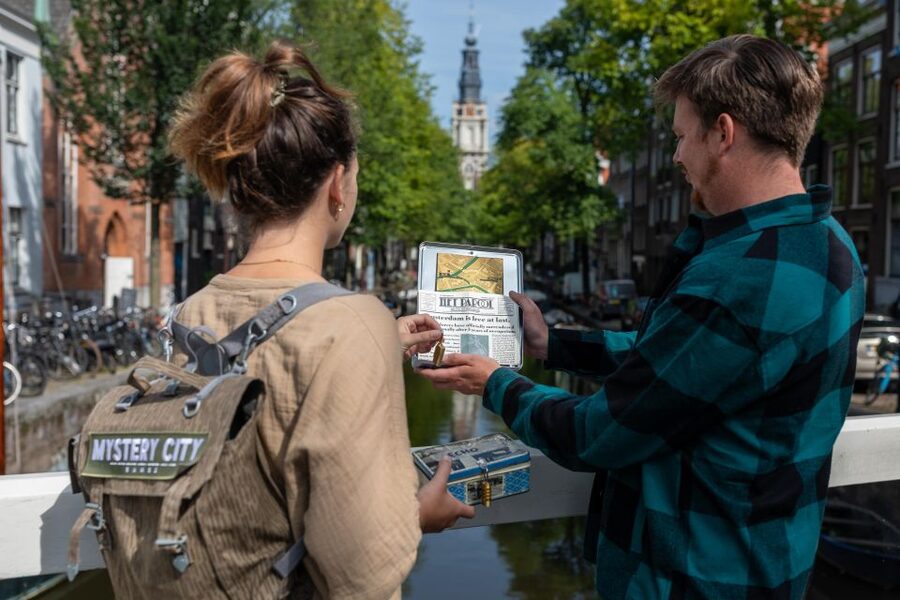
At $29 per person for about a 2-hour walking experience, the value comes from three things: interaction, materials, and story focus.
First, you get a full puzzle structure on foot, not a basic walking tour. Second, you receive physical game gear like maps, boxes, and locks. That matters because you are paying for an experience you can touch, not just for a guide’s narration.
Third, the storyline is tied to WWII and a specific missing-diamonds narrative connected to the Dutch Resistance. You are learning through the game prompts, not only listening to a talk.
One more value point: there is a prize at the end for all participants. It is not going to replace a souvenir, but it does give the game a sense of closure.
What to bring and what to expect day-of
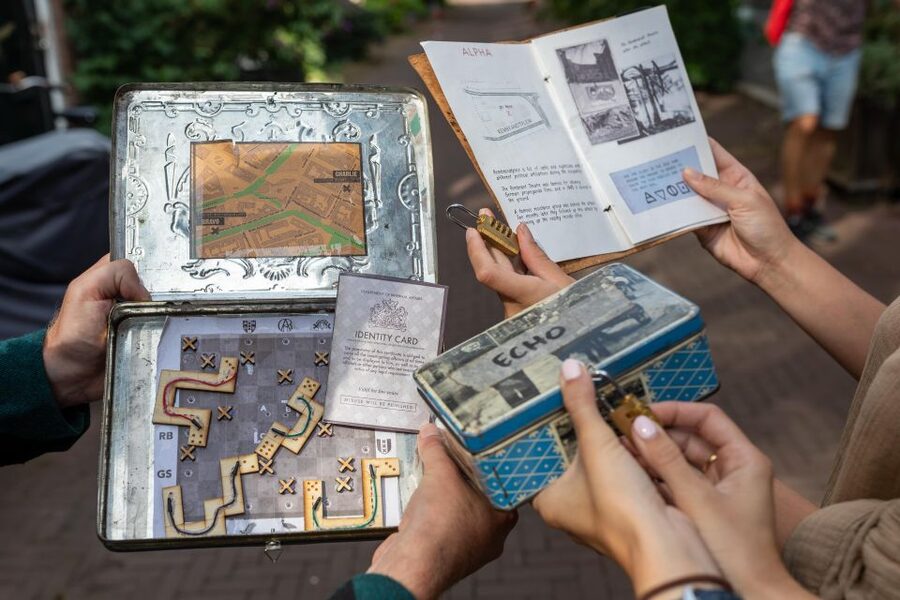
You only need one explicit item: comfortable shoes. Since the route is 3 km and the puzzles slow you down, shoes that support long walking will make a big difference.
Bring a group mindset. This tour runs best when people participate, even if your group members have different puzzle strengths. If someone gets stuck, the rest of you can help by spotting clues in the architecture and cross-checking what the backpack items can do.
Language is English, so expect the Game Master and any on-route interaction to be in English. The game itself is built around puzzle steps, so it is still accessible even if you prefer minimal talking, but you will likely want to understand the storyline and instructions.
Should you book Operation 45 in Amsterdam?
Book it if you want Amsterdam history that you actively work through, with real puzzle gear and a clear mission tied to a true WWII diamond-heist story. It is especially appealing if you like escape-room style challenges and you want to see the old Jewish District sites in a more meaningful way than a standard checklist.
Skip it if you dislike puzzles, or if your schedule cannot handle the possibility of 2 to 3 hours instead of a strict 2. Also consider your mobility situation carefully, since it is a walking route even though it is listed as wheelchair accessible.
If you are the type of person who enjoys noticing building details and turning a walk into a game, this one is a strong pick for an afternoon in Amsterdam.
FAQ
Where is the meeting point for Operation 45?
You meet at Mystery City Games, Zwanenburgwal 178, 1011 JH Amsterdam, Netherlands. Look for the Mystery City Games sign, which is the secret headquarters.
How long is the walking tour?
The duration is about 2 hours, covering a route of roughly 3 km.
What locations do we visit during the hunt?
The hunt includes five different locations in Amsterdam’s old Jewish District. The tour specifically mentions stops such as Shadow Wall, the Portuguese Synagogue, Artis Zoo, and a diamond factory.
Do I need an app for the game?
No. You use a backpack with treasure maps, boxes, and locks. This is not an app.
What should I bring?
Comfortable shoes are recommended since it is a walking route with puzzle stops.
Is it suitable for kids?
It is not suitable for children under 6 years old.
Is it wheelchair accessible?
The activity is listed as wheelchair accessible, but it is also marked not suitable for people with mobility impairments.
Everything Else From Our Amsterdam Notebook





Also Reviewed Around Amsterdam





Puzzle Your Way Around Amsterdam




Fresh off the review pile in Amsterdam
- Full-Day Trip From Amsterdam to Keukenhof, Zaanse Schans + Cruise
★ 5.0 · 3 reviews - Boutique Dutch Food & History Tour with up to 8 guests only
★ 5.0 · 3 reviews - Private Tour to Windmills Zaanse Schans +Keukenhof – 7 Hours
★ 5.0 · 3 reviews - Full-Day Private Guided Countryside Tour from Amsterdam by Bike
★ 5.0 · 3 reviews - Amsterdam Red Light District and Old Town Walking Tour
★ 5.0 · 3 reviews
Walking Tours, compared.
 ★ 5.0Anne Frank’s Story – Guided Walking Tour through AmsterdamFrom $3911,619 reviews
 ★ 4.8Amsterdam: Life of Anne Frank and World War II Walking TourFrom $3710,467 reviews
 ★ 5.0Absolutely Amsterdam – the Essential Introductory Walking TourFrom $53,629 reviews
 ★ 4.8Amsterdam: Anne Frank Guided Small Group Walking TourFrom $282,722 reviews
 ★ 4.9Amsterdam: Anne Frank Walking Tour – Guided in EN/DE/IT/ESFrom $282,676 reviews
 ★ 4.9Amsterdam: Guided Cultural Walking TourFrom $292,384 reviews
 ★ 4.2Amsterdam: Guided Ganja Walking Tour of Coffee ShopsFrom $272,092 reviews
 ★ 5.0Anne Frank Walking Tour Amsterdam Including Jewish Cultural QuarterFrom $751,879 reviews
Browse the lists this tour appears in