
REVIEW · DELFT
Private Walking Tour of Delft: Dive into the Dutch Golden Age
Delft tells its Golden Age in footsteps. This private walking tour helps you connect the big names and the big buildings, with a private guide who turns Delft’s streets into a real story of power, trade, and belief. It is built to be efficient, starting right in the middle of town and moving you between key sites with Dutch Golden Age context.
I especially like the way the route spotlights the people behind the postcards, like Vermeer and William of Orange, not just the facades. You also get a strong sense of place by walking along the canals and stepping into the city’s civic and religious landmarks. One possible drawback is pacing: with about 15 minutes per stop over roughly 2 hours, it is not a slow wander, so if you want lots of time inside each building, you may wish you had a longer visit.
In This Review
- Key Things You’ll Notice on This Delft Golden Age Walk
- Where This Tour Starts, and How the Timing Works
- Market Square to New Church, Delft’s Power in One Block
- Stadhuis Delft: Renaissance Looks, Violent History
- Old Church and the Leaning Tower, Where Art Meets Engineering Drama
- Prinsenhof and 1584: The Orange Dynasty in Delft’s Streets
- Gemeenlandshuis van Delfland: The Water Board House Behind Delft’s Survival
- Armamentarium, the Dutch East India Company, and the Business of Power
- Jewish Community History at Vrienden van de Synagoge Delft
- Beestenmarkt Finish: A Friendly Place to Reset Over Beer and Food
- What the $203.22 Per Group Really Buys You
- Who This Private Delft Walk Is Best For
- Should You Book This Private Walking Tour of Delft?
- FAQ
- How long is the Private Walking Tour of Delft?
- How many people are in a group for this private tour?
- Where do we meet, and can pickup be arranged?
- Is the tour in English, and do I need tickets for the sights?
- What is included in the price?
- What is the cancellation policy?
Key Things You’ll Notice on This Delft Golden Age Walk
- You start and end at the Hugo Grotius statue on the Markt, so you always know where you are headed.
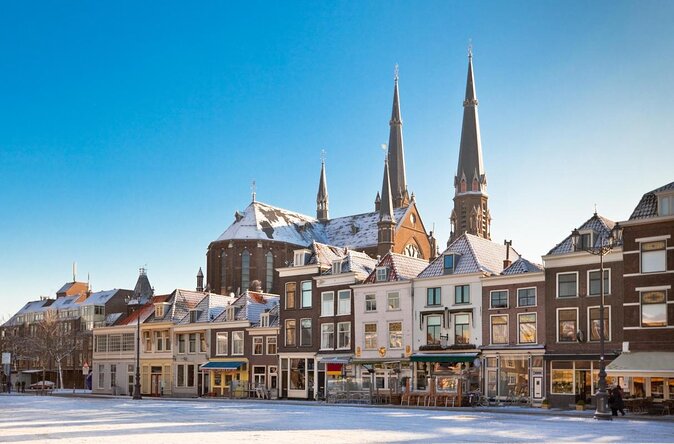
- New Church links royals and thinkers through its royal burials and the legacy of Hugo Grotius.
- The leaning Old Church tower ties together construction drama and art history, with Vermeer connected right inside.
- Prinsenhof explains why Delft matters to the House of Orange, including William of Orange’s assassination in 1584.
- A Water Board building shows how survival worked in the Netherlands, not just how history looked.
- You finish at Beestenmarkt for a practical food and drink reset, with local suggestions from your guide.
Rembrandt, Vermeer and the rest. Further gallery visits
- Vermeer Centrum Delft Museum Admission Ticket★ 4.0 · 45 reviews
- Private Walking Tour of Delft: Dive into the Dutch Golden Age★ 5.0 · 33 reviews
Where This Tour Starts, and How the Timing Works
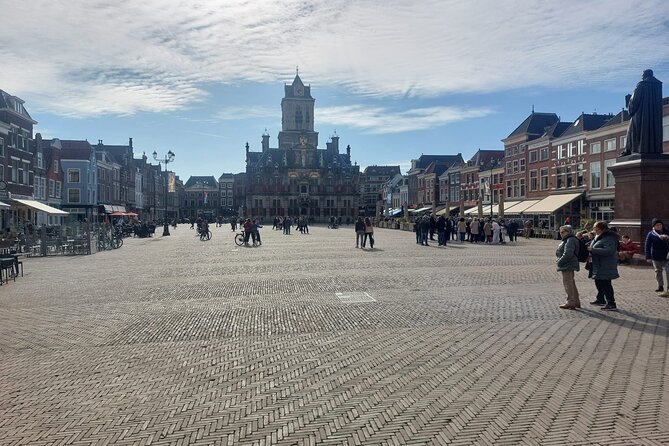
You meet by the Hugo Grotius Statue at GW, Markt in Delft. That matters more than it sounds. Starting on the Markt puts you on the city’s main stage immediately, with easy access to public transportation and an obvious place to re-orient yourself afterward.
The tour runs about 2 hours and is designed as a walk between eight main stops. Each stop is around 15 minutes, so you will get just enough time to see what makes each place important without dragging your feet for hours. It is a great format for a first day in Delft, especially if you are also seeing The Hague or Rotterdam.
This is a private tour, meaning only your group participates. The group size is up to 15, which keeps things social enough for a question or a photo, without turning it into a shuffle. The tour is offered in English, and you get a mobile ticket. If you want pickup, it is available from anywhere in the city centre, which can save you from hunting for your starting corner.
Market Square to New Church, Delft’s Power in One Block
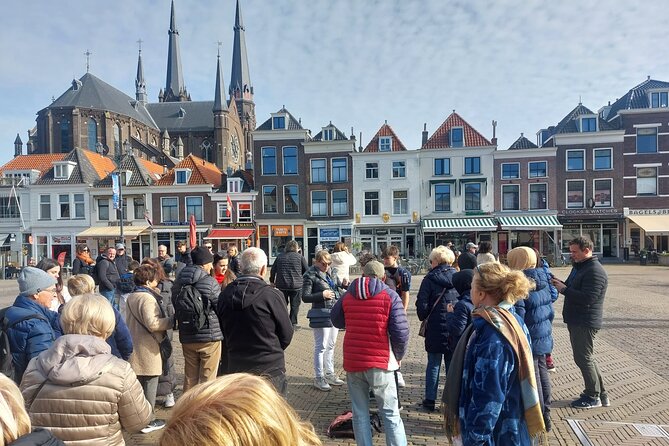
Right away, you are at the Market Square, one of the oldest in the Netherlands, beside the statue of Hugo Grotius. Your guide uses this spot as your anchor, then points you toward the New Church.
At the New Church, the big payoff is what it represents: this is the burial place of the Dutch royal family and also of Hugo Grotius himself. It is not just a church to look at. It is a place where Delft connects intellectual history, religion, and state authority in one tightly packed landmark. The church tower is the second tallest church tower in the country, which gives you a clear visual reference as you talk about how major civic and faith institutions advertised their importance.
What I like about this start is that it sets the tone. You begin by learning what Delft valued enough to monumentalize and protect, then you keep moving toward the city’s civic machinery.
Stadhuis Delft: Renaissance Looks, Violent History
From the Markt, you move toward the Stadhuis Delft, Delft’s historic town hall. Even if you only get a quick view from the route, it is worth paying attention to the façade because it shows how government can look calm even when the past was not.
Your guide connects the Renaissance exterior to a much messier reality behind it. The town hall carried a turbulent mix of fires, justice, and city governance. It also played a role as a former prison. In other words, the building is not just a pretty civic backdrop. It is a reminder that authority often meant control, punishment, and crisis response.
This stop is short, but that is the point. It gives you the “how the city ran” layer before you hit the church and art stops.
Old Church and the Leaning Tower, Where Art Meets Engineering Drama
Next is the Old Church, and it is one of those Delft stops where the architecture has a personality. Before you even reach the church, your guide points out nearby historic buildings on the way that helped shape Delft’s life. You will hear references to places like the former Butter House and the old Weigh House, plus the historic home of Antonie van Leeuwenhoek.
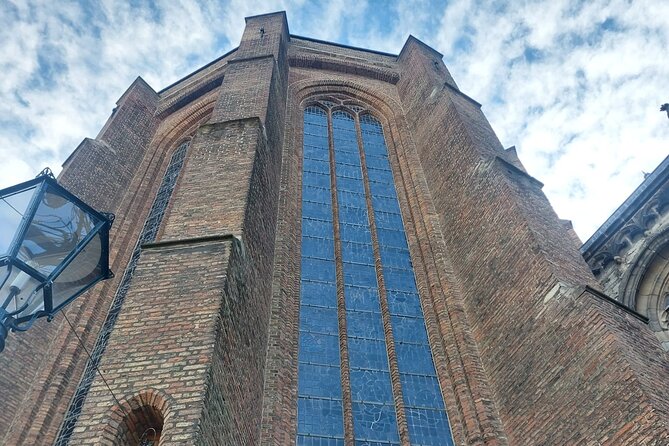
Then you get into the former beer-brewing quarter, and the Old Church appears in that context. The church is famous for its strikingly leaning tower, and your guide explains why it began leaning soon after construction started. That is an unexpectedly human detail. It makes you think about building conditions, soil, and time pressure, not just faith and wealth.
Inside, the Old Church is linked to Vermeer in a very direct way: you see the grave of Johannes Vermeer. You are not left guessing why art fits into Delft’s story. It is physically anchored here.
The only consideration at this stage is practical. Churches can involve stairs and uneven floors, and your stop time is limited. If you are someone who likes to read every plaque slowly, you might need to save extra time for the Old Church on another visit. For this tour, it is best as an efficient primer.
Delft, three more ways

Prinsenhof and 1584: The Orange Dynasty in Delft’s Streets
Across from the Old Church is the Prinsenhof, a former monastery that became a residence for William of Orange. This is one of the stops where the guide’s job gets exciting because the history is intense and personal.
Your guide explains why Delft became tightly linked to the House of Orange, and the key event is William of Orange’s assassination in 1584. That single moment matters because it reshaped the political future of the Netherlands, turning a local location into a national pivot point.
I like Prinsenhof because it gives you cause and effect. You are not only seeing where power was displayed. You are learning where power was decided, and how the stakes turned a city into a landmark on the historical map.
Gemeenlandshuis van Delfland: The Water Board House Behind Delft’s Survival
As you walk along the Oude Delft canal, you reach Gemeenlandshuis van Delfland, home of the Water Board. This is easily the most practical stop on the route, and it is also one of the most memorable.
Your guide points out it is the oldest surviving house in the city, and since 1645 it has housed the local Water Board. If you have ever wondered why the Dutch talk about water like it is family drama, this is where it clicks. A water board was vital to keeping settlements alive, protecting land from flooding, and managing the water systems that made prosperity possible.
This stop can feel different from the art and politics landmarks, but that is exactly why it belongs here. Delft’s Golden Age depended on systems you cannot see from a distance. This building helps you understand the invisible work that let trade and culture flourish.
Armamentarium, the Dutch East India Company, and the Business of Power
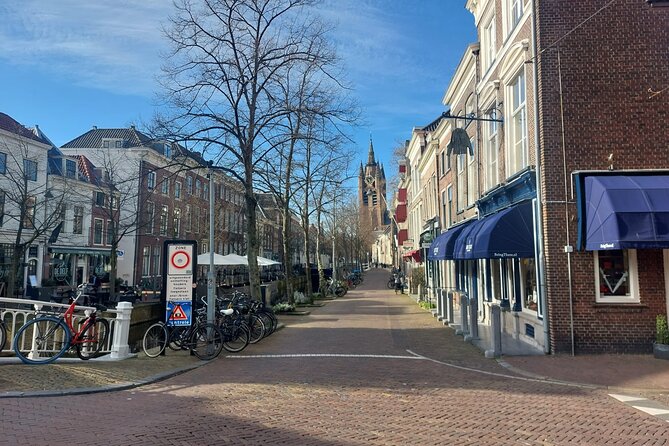
Continuing south along the Oude Delft canal, you pass some impressive historic residences tied to Delft’s rise. Then the route hits two strong Golden Age reminders: the former state weapons armory and the main building of the Delft chamber of the Dutch East India Company.
Your guide connects Delft’s role in military, maritime, and commercial expansion of the Dutch Republic. In plain terms, this is where you see the mix of force and finance. Ships needed money and protection. Trade needed organization and planning. Delft was not just “pretty canal town.” It was a working machine for a growing republic.
There is also a very cool art detail here. Nearby, you can see the exact location where Johannes Vermeer stood when he painted View of Delft. That kind of specific link makes the tour feel personal, even though you are walking with a group and a guide. It turns a famous painting into a literal viewpoint in the city.
Practical note: because this is a walking route, you will want comfortable shoes. The canal areas are photogenic, but you are on your feet the whole time.
Jewish Community History at Vrienden van de Synagoge Delft
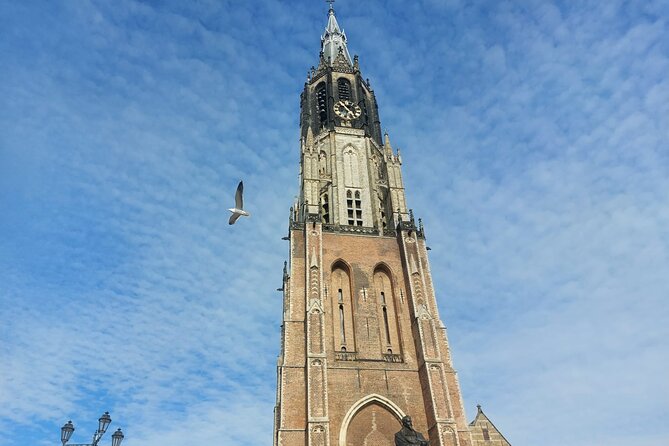
As you head north along Delft’s second-oldest canal, your guide points out the former synagogue building associated with Vrienden van de Synagoge Delft.
This is a quieter stop, but it adds an important layer. The building reflects the long presence of a Jewish community in Delft. Combined with the political, military, and art stops you already saw, it helps you understand Delft as a full society, not only a stage for major figures.
It is also a reminder that historic cities are not one-note. Different communities lived, worked, worshipped, and contributed over centuries, even when the dominant story tends to focus on famous names.
Beestenmarkt Finish: A Friendly Place to Reset Over Beer and Food
The tour concludes at the Beestenmarkt, a former animal market located just behind the Markt where you started. Today, it is one of Delft’s most popular gathering squares, lined with cafés and restaurants.
This is a smart ending. You finish near places where you can keep the conversation going, order a cold drink, and digest what you just learned. If you want, your guide can share local tips for a good beer, casual snacks, or a relaxed dinner so you keep moving without wasting time guessing.
What the $203.22 Per Group Really Buys You
This tour is priced at $203.22 per group for up to 15 people. That structure can be a great deal if you are traveling with family or friends, because the “cost per person” drops quickly as your group size grows.
It is also a fair price if you want guidance through the city’s dense history without spending extra money on ticketed sites. The itinerary indicates the key stops are admission ticket free, so you are mainly paying for the private guide and the time saved by not figuring it out on your own.
The real value is in the synthesis. The guide connects buildings to events like William of Orange’s assassination, adds practical meaning to the Water Board, and ties Vermeer to exact locations. If you like your history connected to real street corners, this is money well spent.
Who This Private Delft Walk Is Best For
I think this tour is ideal if:
- You want a first-time orientation to Delft’s Golden Age without a long day.
- You like learning about why places mattered, not only what they look like.
- You are traveling with mixed ages, since the route is designed to be flexible and your guide can adapt to a group’s needs.
- You want art history in a practical form, like seeing Vermeer related sites and even the viewpoint for View of Delft.
It may be less ideal if:
- You want a slow, lingering crawl through museums and churches.
- You need a lot of time inside buildings, since stop times are relatively short.
Should You Book This Private Walking Tour of Delft?
Yes, if you want a high-impact, guided walk that ties together Delft’s art, politics, trade, and water management in about two hours. The strongest reason to book is the way the guide turns landmarks into linked stories: New Church, leaning Old Church, Orange history at Prinsenhof, and the Water Board reality check all feel like they belong together.
If you are short on time in Delft, this is a smart way to get your bearings fast. If you have plenty of days, I’d still book it early, then revisit your favorite stop on your own so you can go slower where you care most.
FAQ
How long is the Private Walking Tour of Delft?
The tour lasts about 2 hours.
How many people are in a group for this private tour?
It is a private tour for your group only, with a maximum group size of up to 15 people.
Where do we meet, and can pickup be arranged?
You meet at the Hugo Grotius Statue on the Markt in Delft. Pickup is available if you are in the city centre, and you just need to request it.
Is the tour in English, and do I need tickets for the sights?
The tour is offered in English, and the stops listed include admission ticket Free.
What is included in the price?
The price includes a private guide and all fees and taxes.
What is the cancellation policy?
You can cancel for a full refund up to 24 hours before the experience starts. If you cancel less than 24 hours before, the amount paid is not refunded.
Also Reviewed Around The Hague




Delft, Three More Ways




The Dutch Masters, Up Close
Fresh off the review pile in The Hague
- Private Tour of Vermeer’s Delft + Tickets to Vermeer Museum
★ 5.0 · 3 reviews - Private Tour of Rotterdam and The Hague including Transfer
★ 5.0 · 3 reviews - Surfing at The Shore in The Hague
★ 4.5 · 3 reviews - 3 Course Walking Dinner in Delft with Guided Tours in Between
★ 5.0 · 3 reviews - Surprise Walk of The Hague with a Local
★ 4.5 · 3 reviews
Delft & Delft Blue, compared.
 ★ 4.2From Amsterdam: Rotterdam, Delft & The Hague Guided Day TourFrom $901,765 reviews
 ★ 4.4Delft: Canal Cruise with Guided CommentaryFrom $15990 reviews
 ★ 4.0Rotterdam, Delft, the Hague, Madurodam from AmsterdamFrom $90793 reviews
 ★ 4.5Rotterdam, Delft and The Hague Small Group Tour from AmsterdamFrom $151599 reviews
 ★ 4.6Royal Delft: Delftblue Factory and MuseumFrom $21588 reviews
 ★ 4.2From Amsterdam: Guided Trip to Rotterdam, Delft & The HagueFrom $81529 reviews
 ★ 4.5The Hague, Delft and Rotterdam Small-Group Tour (Max. 8 People)From $156234 reviews
 ★ 4.4Delft: Entrance Ticket for the Old and New ChurchesFrom $11229 reviews
Browse the lists this tour appears in